PPC for accountants can work. But only under one condition. The firm has to target the right client, not the cheapest click.
Most accounting firms waste money here. They judge campaigns by clicks. Not by qualified leads. Not by signed clients. Before you spend more, check two things. Does your service have real buyer demand? And can you track a lead all the way to revenue?
Does PPC Work for Accounting Firms in 2026?
Yes, for most firms. But results depend a lot on the setup. Google Ads for accountants work best when a firm sells one clear service. The buyer already knows they need help now.
When Google Ads Work Best for Accountants
A few things tend to line up when PPC for Accountants works well.
The search shows buying intent. The service is specific, not vague “accounting help.” The firm serves a clear area or a defined remote niche.
Client value is high enough to cover a fair cost per lead. The landing page matches the search. Tracking is solid, and follow-up is quick.
Miss a few of these, and even a good campaign will struggle.
When PPC Becomes Unprofitable
PPC drains money instead of growing the firm when targeting is loose. It also fails when tracking is weak, or every visitor lands on a plain homepage.
Off-topic searches quietly waste spend. So do weak client numbers and fake conversion counts. The reports can still look busy. None of it turns into real clients.
Why Your Accounting PPC Campaign Is Not Converting
Getting Clicks but No Inquiries
Clicks look healthy, but the phone stays quiet. Start with the landing page. Does it answer the exact search? Does it load fast on mobile? Is the next step obvious?
Getting Inquiries but No Qualified Clients
Many inquiries are not real prospects. Job seekers apply. Students research courses. People search for free software.
Some contact you from the wrong city. Others ask about a service you do not even offer. These all fill up your dashboard. None of them move revenue.
Getting Qualified Leads but No Clients
Sometimes the campaign is fine. The problem sits further down the chain.
Common causes include slow reply to times and unclear pricing. A clunky consultation process hurts too. So does a missing CRM to track follow-up.
Why Increasing the Budget Is Not Always the Answer
A leaking campaign does not need more fuel. If it already wastes money through poor targeting, more spend means more waste.
How Much Do Google Ads Cost for Accountants?
Accountant Google Ads cost shifts with service, location, and competition. No single number fits every firm.
What Determines Accountant Google Ads Costs?
Cost per click depends on several factors. The service you advertise matters. So does the area you target and how many firms compete there.
Search intent plays a role too. So do your bidding choices and keyword matching. Landing page quality and busy seasons, like the run-up to self-assessment, also push cost up or down.
CPC vs CPL vs Qualified CPL vs Customer Acquisition Cost
| Metric | What it measures |
|---|---|
| CPC | What you pay per click |
| CPL | Spend divided by every enquiry, qualified or not |
| Qualified CPL | Spend divided by enquiries that fit your target client |
| Customer acquisition cost | Spend divided by clients who actually signed |
A low CPC means little if qualified CPL is high. A low CPL means just as little if few leads turn into real clients.
Why Average PPC Benchmarks Can Be Misleading
A tax accountant chasing self-assessment work runs on different numbers than a bookkeeping firm with monthly clients. London competition looks nothing like a small regional market either.
Treat any “average CPC for accountants” figure with care. If it doesn’t state its source and date, don’t trust it.
How Much Should an Accounting Firm Spend on Google Ads?
Is £500 Per Month Enough?
It can support a small test. Think one strong service in one town.
But it rarely gives Smart Bidding enough data to learn from. In busy markets, it may run out mid-month too. A tight, small test makes sense. Spreading that same budget across several services usually does not.
Build the PPC Budget Around Client Value
A defensible Google Ads budget that accountants can justify follows one simple chain. Client value sets a fair acquisition cost. That cost, combined with your close rate, sets a fair cost per lead. Multiply that by your expected lead count, and you have your budget.
When Should an Accounting Firm Increase Its PPC Budget?
Check a few things first. Is lead quality strong? Is tracking accurate? Are search terms clean, and does the page convert well? You also need spare room to take on more clients. There is little point in more leads than the firm can handle.
How to Choose PPC Keywords for Accountants
Put buying intent ahead of raw search volume. “Payroll accountant for small business” converts better than plain “accountant,” even with fewer searches.
Location terms carry strong intent too. Think “accountant near me,” or a city plus a service. The searcher is already narrowing down who to call.
Niche terms work the same way. Think ecommerce, property, contractors, or startups. The searcher wants someone who knows their world, not a generalist.
Switching-accountant searches deserve attention too. Someone looking to leave their current accountant is further along than someone still learning the basics.
Broad Match vs Phrase Match vs Exact Match
Google Ads still runs on three match types: broad, phrase, and exact. What has changed is how each one behaves. Google now leans on AI to read meaning, not just match words.
When Broad Match Can Work
Broad match can find searches you would never think to add by hand. But it needs solid conversion data feeding Smart Bidding. Without that signal, it can pull in searches that have little to do with accounting.
When Tighter Keyword Control Makes Sense
Phrase and exact match still suit tight budgets and niche services. They also work well for new campaigns that lack enough history for automation to learn from.
Why Search-Term Reports Still Matter
A keyword is what you added. A search term is what someone typed.
Check the search terms report often. It is the only way to see what broad and phrase match are really pulling in.
Negative Keywords for Accounting Firms
- Job and career searches, such as “accountant jobs”
- Course and training searches, such as “accounting course”
- Free or DIY searches, such as “free tax calculator”
- Software searches, such as “Xero login”
- Other searches with no link to your services
Build these lists from your own search data. A generic copied list will always miss something specific to your firm.
How to Structure Google Ads for an Accounting Firm
A clear structure runs from campaign to service, then ad group, keyword, ad, and landing page.
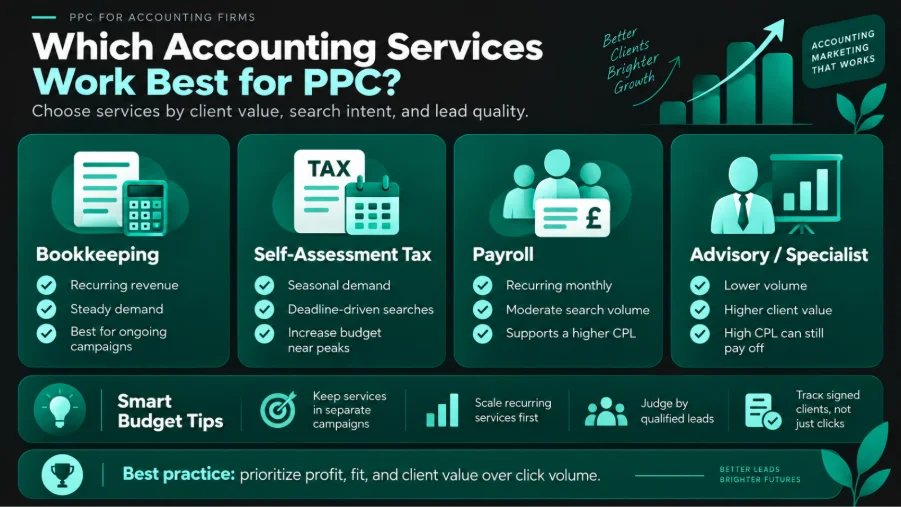
Bookkeeping, tax, and payroll each carry different intent and busy seasons. They usually deserve their own campaigns, not one shared budget. Keep high-value work apart from low-margin compliance tasks too, so spend stays easy to control.
Brand campaigns protect your name from rivals. Non-brand campaigns bring in new demand. Keep them apart, and results become far easier to read.
Firms serving several regions often gain from splitting campaigns by place. Averaging results across areas that behave differently hides the real picture.
Search Ads vs AI Max vs Performance Max for Accountants
Standard Google Search campaigns give you the most control over keywords, bids, and targeting. Most firms should start here.
AI Max for Search is not a new campaign type. It is an extra layer added on top of Search campaigns.
It runs on two parts. Search term matching uses broad match and keyword-less tech to find good queries beyond your list. Asset optimization writes tailored ad copy and can send visitors to the best page on your site.
Google says AI Max reached full availability in 2026. Older broad match settings and Dynamic Search Ads are moving across through 2026 and into 2027.
Whether accountants should use it depends on the account. A firm with solid tracking and good history can test AI Max. Keep brand exclusions and location controls turned on while you do. A firm still fixing basic tracking should sort that out first.
Performance Max runs across Search, Display, YouTube, and Discover. It uses fully automated bidding and creative, with far less manual keyword control than Search campaigns.
| Factor | Search | AI Max for Search | Performance Max |
|---|---|---|---|
| Control | Highest | Moderate, with added controls | Lowest |
| Automation | Manual bidding available | Layered AI on Search | Fully automated |
| Keyword use | Core to targeting | Keywords plus AI expansion | Minimal, signal based |
| Reach | Search only | Search only | Search, Display, YouTube, Discover |
| Conversion data needed | Lower | Moderate to high | High |
| Best use case | New or specialist campaigns | Established accounts scaling reach | Strong trackers wanting broader reach |
No option wins every time. The right fit depends on how much history and control the firm has right now.
PPC Bidding Strategies for Accounting Firms
Maximize Clicks suits early tests, before you have much conversion data. Maximize Conversions pushes bids toward whatever counts as a conversion, so clean tracking matters a lot.
Target CPA holds cost per conversion near a set goal. It needs decent volume to work well, though. Value-based bidding helps Google favor inquiries likely to become higher-value clients. This helps most where services carry different worth.
Smart Bidding depends fully on conversion quality. Say Google’s system treats a job-seeker form and a real bookkeeping enquiry as equally valuable. It will chase whichever one is easier to get. That is often the wrong one. The system learns only from clean conversion data.
How to Write Google Ads That Attract Accounting Clients
Match the ad to the search. An ad for “payroll accountant” should talk about payroll, not general services. That filters out the wrong clicks before they even happen.
Use real points of difference where they are honestly true. Sector know-how, fast response times, clear pricing, and an easy switching process all work well when real.
Responsive search ads let Google test different headlines and lines together. Extra assets, like sitelinks and callouts, add more detail without cluttering the main ad.
Accounting PPC Landing Pages: Homepage or Dedicated Page?
Sending every visitor to the homepage is a common reason accounting PPC landing pages fail. A homepage tries to serve everyone, so it often serves each searcher poorly. This mismatch gives visitors an easy reason to leave.
A strong page does a few things at once. It pairs a service heading with a clear line that speaks to the visitor’s problem. It shows the location where that matters and states the value plainly.
Add proof, such as reviews or credentials. Outline the process step by step. Point to one clear next action, with contact options nearby.
People looking to switch accountants want reassurance too. They think about the transfer, how records move across, likely disruption, and a real timeline.
Small technical details matter more than they seem. Check mobile speed, load time, HTTPS, and working forms. Check that tracking fires correctly. Check that Google’s AdsBot crawler can reach the page. A small fault can quietly break your tracking with no warning.
How to Track PPC Leads Through to Paying Accounting Clients
A real enquiry should count as a conversion. That means a call, a form, or a booked meeting. A page view should not.
Tracking drop-off means tracking the full path. Click, enquiry, qualified lead, meeting, proposal, signed client, revenue.
Google Ads tracking, GA4, and call tracking together give a fuller picture than any one tool alone. Phone calls often carry more weight than form fills for accountants, so call tracking earns its place.
Link your ad platforms to your CRM through offline conversion tracking. That feeds real sales outcomes, not just form fills, back into Google Ads. The cleaner your tracking, the better Smart Bidding and AI Max can learn what a good lead looks like.
PPC Metrics Accounting Firms Should Actually Measure
| Metric | What it tells the firm |
|---|---|
| CTR | Whether the ad is relevant enough to earn a click |
| CPC | What each click costs |
| Conversion rate | How well the landing page turns visitors into enquiries |
| CPL | Cost per enquiry, qualified or not |
| Qualified CPL | Cost per enquiry that fits your target client |
| Consultation rate | How many qualified leads book a consultation |
| Close rate | How many consultations become signed clients |
| CAC | True cost to acquire one paying client |
| Client value | What that client is worth over time |
| ROAS/ROI | Return relative to spend, where tracked accurately |
A cheap CPC does not mean profitable PPC. A cheap CPL does not mean good leads either.
Why Your Accountant PPC Campaign Is Not Converting
| Problem | Likely cause | What to check |
|---|---|---|
| Impressions but few clicks | Weak ad copy or poor position | Rewrite headlines, review bids |
| Clicks but no enquiries | Landing page mismatch | Page relevance and speed |
| Many low-quality enquiries | Broad targeting, missing negatives | Search terms report |
| Job seekers applying | Missing career negatives | Add job and training negatives |
| High CPC | Competition or low Quality Score | Keyword relevance and ad quality |
| Budget exhausted quickly | Broad targeting or tight daily cap | Search terms and pacing |
| Qualified leads but no clients | Slow follow-up, unclear pricing | Response time and sales process |
| Inflated conversion numbers | Tracking counting weak actions | Audit conversion actions |
| Ad disapprovals | Policy or landing page issue | Google Ads policy centre |
| Automation producing poor leads | Weak conversion signals | Clean up what counts as a conversion |
Local PPC Strategy for UK Accounting Firms
A firm serving one city needs tight radius targeting. A firm serving clients remotely across the UK can often go wider, as long as the ads reflect that reach honestly.
“Accountant near me” searches usually mean the person is ready to compare options fast. Fast reply times matter a lot here.
Set location targeting based on where your clients come from, not just where your office is located. The cost per clicks for accounting firm PPC in the UK, especially in markets like London, often differs from that in regional areas. Actual costs vary too much by service and month to give one fixed figure.
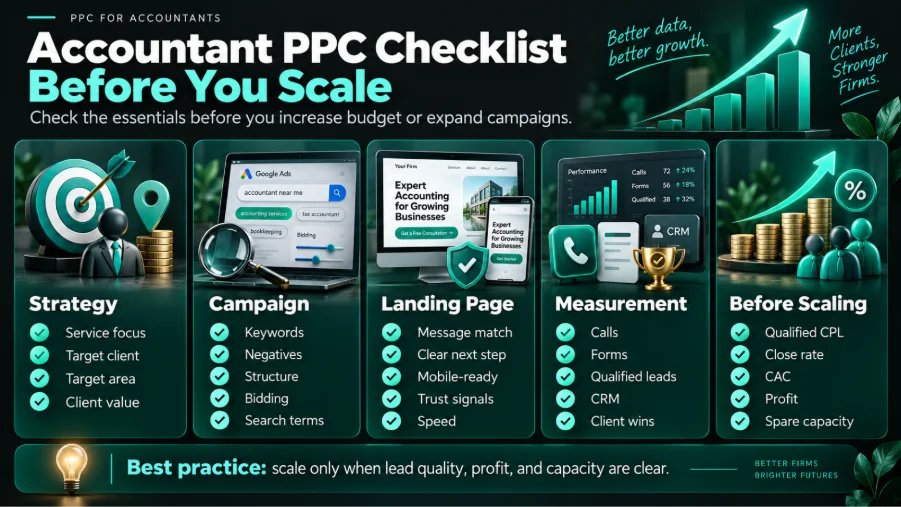
Google Ads Policies and Technical Issues Accountants Should Know
Financial ads get checked more closely than many other industries. Disapprovals can come from unclear claims, missing certifications, or a page that does not match the ad. Check Google’s current financial services policy before you launch.
Technical faults can block ads too. A firewall blocking Google’s crawler, a broken link, or a server error can all stop AdsBot from reaching your page. That hurts delivery.
Tracking has its own common failure points. Duplicate tags, broken forms, missing pixels, and incorrect conversion setup can create data that looks active but doesn’t reflect reality.
How to Calculate Whether an Accountant PPC Is Profitable
Start with what an average client is worth over a full relationship. Not just their first invoice. Decide what share of that value you’re willing to spend to win them. Then track how many qualified leads become paying clients.
Maximum affordable CPL = acceptable customer acquisition cost × lead-to-client conversion rate
Here is one example only, not a rule. A firm with a £600 acquisition cost that closes 25% of leads has a max affordable CPL of £150. Every firm’s number will differ.
Conclusion: Choosing the Right PPC Strategy for Your Accounting Firm
The right PPC strategy depends on where your accounting firm stands today. A smaller local practice should start with one valuable service, a defined location, and a controlled Search campaign. Build reliable tracking before increasing the budget. If clicks arrive but enquiries do not, fix the landing page and search intent first. More budget will not repair a weak conversion path.
If enquiries are coming through but few become suitable clients, review search terms, negative keywords, lead qualification, and the actions Google is using as conversion signals. Firms with reliable tracking and proven client economics can then consider larger budgets, AI Max testing, and more advanced automation.
The best PPC for accountants is therefore not the campaign producing the cheapest clicks. It is the one that consistently turns relevant searches into qualified prospects and profitable client relationships.
Turn Your PPC Spend into Better Accounting Leads
Running Google Ads is easy. Knowing which campaigns, keywords, landing pages, and conversions are actually helping your firm grow is harder.
A8OM helps accounting firms build and manage PPC around real business outcomes. Our approach focuses on search intent, campaign structure, landing-page performance, conversion tracking, lead quality, and sustainable customer acquisition costs.
If your accounting firm is spending on Google Ads but cannot clearly see which activity is producing valuable clients, speak with A8OM. We can identify where budget is being lost, what needs improving, and where your next PPC investment can work harder.
Frequently Asked Questions
Only when pricing is simple, competitive, and unlikely to mislead. Showing a genuine starting price can filter out poor-fit enquiries. However, firms with complex or tailored services may be better directing prospects to a consultation instead.
Yes, but the landing page must work harder to build trust. Clear qualifications, specialist experience, transparent processes, professional accreditations, and realistic service claims can help. Reviews should be added as genuine client feedback becomes available.
Usually, reducing or pausing campaigns is better than paying for leads you cannot serve. Another option is to lower budgets or keep only high-value campaigns active. PPC spending should always reflect the firm’s current capacity to take on new clients.
Usually not. One well-structured account can manage several locations through separate campaigns and location targeting. Separate accounts may make sense for legally distinct businesses or brands, but they can make tracking and management more complex for one accounting firm.