Introduction
Here’s something nobody tells you when you start a small business. You can do content marketing for a full year and have almost nothing to show for it. Not because content marketing doesn’t work, but because most small businesses way it the wrong way from day one.
The usual story goes like this. Someone reads that “content is king” and starts a blog. They write six posts in the first month, then life gets busy,, and it becomes two posts, then one, then nothing. Or they post on LinkedIn for eight weeks, get a handful of likes, see no new leads, and quietly give up.
That’s not a content marketing failure. That’s a planning failure.
Content marketing, done well, is one of the most cost-useful growth tools a small business can use. It costs 62% less than outbound marketing and brings in roughly three times more leads. But those numbers only apply if you go in with a plan, not just a posting schedule.
This guide covers the whole picture. What works. What often goes wrong. How to build a content plan that suits a business for of your size.
Why Content Marketing for Small Businesses Often Fails
The problem usually isn’t a lack of effort. Most small businesses do try. The issue is that they treat content as a task rather than a system.
A task gets done when there’s time for it. A system runs whether you feel like it or not.
There’s also a timing problem. Content marketing is slow by nature. A blog post published today might not rank on Google for several months. Once it does rank, though, it can keep bringing in free traffic for years.
Compare this to paid ads. Paid searches drive traffic fast. Results in 48 hours. But the moment you stop paying, the traffic stops too. Content doesn’t work like that. It builds. And that’s exactly the point.
If your business can’t wait six months, run paid ads now alongside content. If you can put in on a set schedule and play a longer game, content will beat almost every other channel on cost-per-lead by year two.
What Content Marketing Actually Includes
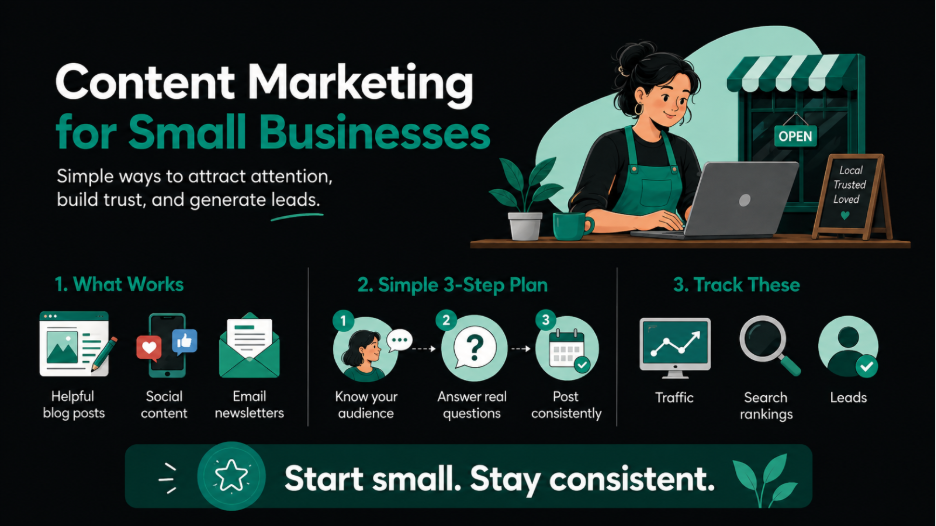
People use the phrase to cover everything from blog posts to short videos to email newsletters. All of it counts as content marketing. The common thread is that you’re creating something that helps your audience, rather than interrupting them with a sales pitch.
That distinction matters. A Google ad buys focus. A blog post that answers someone’s actual question earns it. Paid ads stop when you stop paying. Content keeps working long after it’s published.
For small businesses, here are the main channels worth knowing.
Blog Content and SEO
This is the base. Blog posts sit on your website and build over time. They’re the primary drivers of free search traffic. A well-ranked post for a term like “accountant for freelancers in Manchester” can bring in ten to twenty leads a month without you doing anything.
The key: write for search intent, not just topics you find interesting. For small businesses looking to grow through free search, pairing blog content with professional SEO services for small businesses is often the fastest way to make the content work harder.
Social Media Content
Social media works differently depending on your market. LinkedIn tends to perform well for B2B service businesses. For local consumer businesses, Facebook and Instagram still hold up well. Short-form video is getting strong free reach across most platforms right now. If you’re not using it, you’re leaving a real sharing advantage on the table.
The mistake most small businesses make is treating social as their main channel. It isn’t. Social media is where you share content. Your website is where it lives and is built. A well-run social media content strategy supports your blog, not the other way around.
Email Marketing
Email is the most underrated of the three. It doesn’t depend on any feed. You own your list. The people on it want to hear from you. That makes them warmer than almost any audience you can reach through paid or free channels. Email averages around £36 back for every £1 spent. That beats every other channel.
Video Content
91% of businesses now use video in some form. No production setup is needed. A phone video filmed in decent light, with you explaining something your buyers often get wrong, can outperform a polished but hollow branded video.
Building a Content Strategy That Works
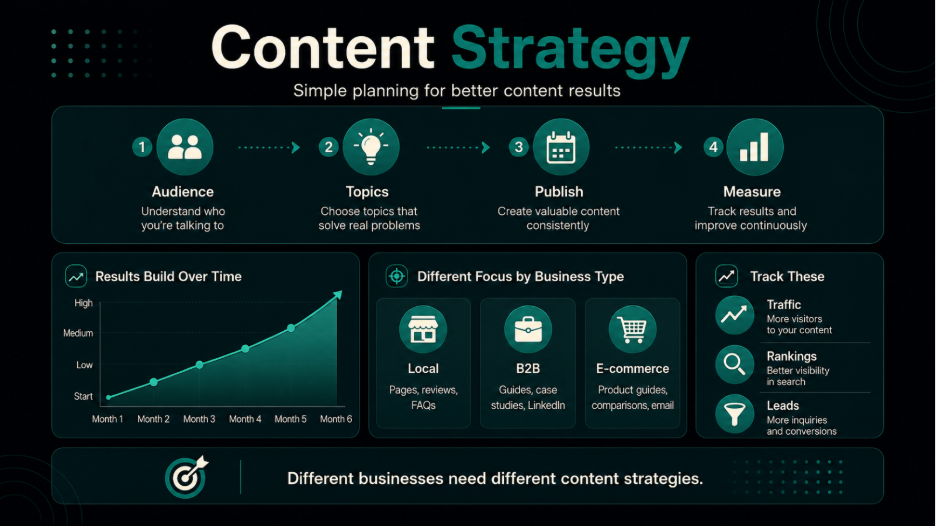
The word “strategy” sounds harder than it is. For a small business, you don’t need a 40-page document. You need honest answers to a handful of questions.
Know exactly who you’re talking to
Not “SMEs” or “local homeowners.” Get narrow. If you’re a lawyer, are you writing for first-time buyers, landlords, or businesses in a commercial dispute? Each of those is another reader with other questions and other search behavior. Content that talks to all ends up useful to none.
Find out what they’re in fact searching for
This is where most small businesses go wrong. They write about what they find interesting. Or what they think sounds good. Not what their buyers type into Google at 11pm when they need an answer.
Google Search Console is free and shows you exactly what search terms are already bringing people to your site. Answer The Public shows you the questions people ask around any topic. Ahrefs and Semrush have free tiers too. Spend an hour on this before you write a word.
Pick an honest posting pace
The worst thing you can do is commit to four posts a week and burn out by month two. Two solid posts a month, posted without fail, beat ten in January and nothing in February. Every time. The feed rewards showing up.
Decide how you’ll measure progress
Set a handful of simple metrics before you start. Free traffic. Email list size. Number of leads from people who mention your blog or found you through search. You don’t need sixty KPIs. You just need enough data to know whether to keep going or change direction.
The Content Plan: Month by Month
The first ninety days are the hardest. Effort in, nothing visible out. Here’s how to think about each phase.
Month one: base
Pick your top ten content topics based on keyword research, not instinct. Set up a basic content plan. Write and post your first two posts. Don’t worry about them being perfect. Getting something live matters more than getting it perfect.
Months two and three: build the habit
Stick to your schedule. Track what is happening. See which posts get traction. Start getting email sign-ups, even just a form at the bottom of your site.
Months four to six: look at the data
You should see early movements in search rankings by now. Some posts will be doing better than others. Double down on the themes that are getting a response. Start linking your posts to each other.
Six months onward: build
This is where it pays off. Your older posts are now ranking. New posts benefit from the trust your site is building. Updating a post from six months ago often delivers better results than writing something new. Treat old content as an asset, not an archive.
Content Marketing for Local Businesses
If your business serves a clear area, local content is one of the highest-return activities you can do.
Local search carries strong intent. “Boiler repair in Sheffield” or “employment solicitor near me” are searches made by people who are close to buying. Ranking for those terms for free is fully possible if you are way it right.
The real side isn’t hard. Each town you serve needs its own page. Not a copy-paste version with just the place name swapped. Google spots that fast. Each page should have something locally useful: a real guide, a local case study, or data clear to that area.
Google Business Profile posts are also worth using on schedule. Most local businesses claim their profile. Then ignore it. Posting short updates and tips keeps the profile active and signals to Google that you’re a real, current business.
Local case studies are especially powerful. A London flooring company that writes about a specific job in Hackney, including the real challenge and how they solved it, will build more trust with local readers than a weak “we do great work” page ever could.
Small businesses wanting to grow locally and for free, a solid digital marketing approach built for small businesses covers these channels as one connected system rather than separate tactics.
Content Marketing Cost: What You’re Actually Looking At
UK pricing for content marketing varies a lot based on who does the work and how much you need.
A basic agency retainer that includes strategy, two to four blog posts a month, and basic sharing typically runs from £800 to £3,000 per month. Single blog posts from freelance writers range from £100 to £400 based on length and complexity. A full-service agency with multiple channels, paid social, and reporting will sit above £3,000 a month. Content audits are a good starting point if you already have content on your site and typically cost £100 to £700.
If the budget is tight, there are two honest options. The first is to do it yourself, which costs time but not money. The second is to use AI tools to speed up the writing process. About 51% of small businesses are taking this route now. The catch is that AI alone produces weak output. It needs a real strategy behind it and a human voice on top of it.
One thing to avoid: very cheap bulk content from content mills. Google has gotten much better at finding thin, low-quality material, and it can actively hurt your rankings rather than helping them. One well-researched post a month beats ten rushed ones every time.
When Standard Content Advice Doesn’t Apply to You
Most content marketing guides are written for businesses with a team, a budget, and an online audience. That’s not every small business. Here’s who tends to struggle most with the standard playbook, and what in fact works instead.
Sole traders doing all of it themselves
Writing useful content while running a business is truly hard. It competes with client work, admin, invoicing, and all else. If this is you, scale down your hopes. One solid post every two to three weeks is enough to build progress over time. The goal isn’t volume. It’s showing up at a pace you can in fact hold.
Very niche B2B businesses
If only three hundred people a month search for what you do, ranking for those terms won’t transform your business. Standard blog SEO has limited upside here. These businesses often do better with thought leadership on LinkedIn, guest posts on industry sites, and direct outreach than with a content-first way. The audience is too small for broad content to move the needle.
Businesses starting from zero online
No website trust. No backlinks. No existing content. Starting from scratch is slow, and that’s normal. You’ll spend the first six months building a baseline before results appear. The trap is expecting blog SEO to work at month two. It won’t. Pair early content with some technical SEO services that build organic trust so that when the content does start to rank, the site is ready to buy.
Regulated industries with sign-off processes
Financial services, legal practices, and healthcare businesses often need compliance approval on every piece of content before it goes live. That adds weeks to posting timelines and kills progress fast. Build sign-off time into your content plan from day one. Better still, keep a bank of pre-approved evergreen content ready to go.
Common Mistakes That Hold Small Businesses Back
Most content marketing guides talk about what to do. This section is about what goes wrong in practice, based on patterns that show up repeatedly.
Publishing content and then doing nothing with it:
A post on an empty website with no email list, no social sharing, and no links will get zero traffic. Full stop. Creating content is only half the job. Distributing it through email, social, and links from related pages is the other half. Most small businesses skip this completely and then blame the content when nothing happens.
Writing about the wrong things:
It feels productive to write about company news, product launches, and team updates. Your buyers don’t search for any of that. They search for answers to their problems. The businesses that build real traffic write about buyer problems. Not what the business is proud of.
Stopping too early:
This is the costliest mistake in content marketing. The payoff builds over time. Businesses that stop at month three often do so right before they would have start seeing results. If you’re going to put in content, give it at least six months before you judge. Judging it earlier is like pulling up a tree after two weeks because it hasn’t grown.
Ignoring the content you’ve already published:
A post from a year or more ago might be sitting on page two for a genuinely valuable keyword. A few hours of updates, fresher data, and sharper structure could push it up. That’s often a faster win than writing something new, and it’s a step a lot of businesses overlook.
Giving readers no clear next step:
Useful content that never tells the reader what to do next leaves opportunities on the table. Every post should point to the reader toward a logical next action, whether that’s signing up for your email list, reading a related post, or getting in touch.
What a Content Audit Tells You
If you already have pages and posts on your site, an audit is the right starting point before you create anything new.
An audit maps what you have against what’s performing. You’re looking for posts that rank on page two. Those are worth updating. Content with high traffic but poor sales need a better call to action. Spot gaps where your rivals rank, but you don’t. Find old posts with outdated data.
You don’t need specialist tools for a basic audit. A spreadsheet with your URLs, their ranking positions from Search Console, and a quick note on their good and age is enough to start. From there, rank what to update, what to grow, and what to cut.
Content Marketing for Startups
Startups are often grouped in with small businesses, but they face a different challenge. They need awareness and leads quickly, often on a very small budget and without any established domain authority.
The most effective approach is usually to go narrower than you feel comfortable. Instead of positioning “the best project management tool,” aims to be “the best one for freelance designers.” Instead of a general marketing blog, write in depth about one problem your ideal buyer faces. A tighter focus tends to get faster results.
Guest posts on established sites with existing readerships can help speed this up early on. If your own site has no authority yet, borrowing someone else’s is a reasonable strategy.
Email deserves more attention from startups than it usually gets. A visitor who leaves your site without buying is likely gone for good unless you capture their email first. A simple lead magnet, a checklist, a short guide, a useful template, can turn a passing reader into someone you can reach again.
For startups looking to bring SEO, social, content, and email together from the start, and all-in-one growth system can take the guesswork out of deciding which channel to prioritise first.
Frequently Asked Questions
For most small businesses, you’ll see early movement in search rankings between months three and six. Meaningful traffic and leads tend to follow at six to twelve months. The exact timeline depends on how crowded your market is and how you post on schedule. In highly crowded niches, it can take longer.
They do other jobs. Social media content lives and dies within hours, maybe a day or two. Blog content can rank and bring in traffic for years. Social is great for building a following and getting short-term response. A blog builds long-term search equity. You ideally want both. Use social media to share what you write.
Both approaches work. In-house content tends to be more authentic because you know your buyers and your business better than any agency. The problem is time. Agencies bring showing up and specialist skills but cost more and can feel weak without good briefing. Many businesses that do this well use a mix: they brief the topics and provide the knowledge, and a freelancer or agency does the writing.
Start with what your buyers ask you. Those questions are content topics. Then use Google Search Console to see what searches are already bringing people to your site and build from there. If you’re starting fresh, tools like AnswerThePublic show you the questions people ask around any keyword.
It depends on who does the work. Doing it yourself costs the most, most of the time. Outsourcing to a freelancer for two posts a month might run £200 to £800 per month. An agency retainer starts around £800 and goes up from there. The right budget is the one you can hold for at least six months.
Yes, possibly more than before. AI search tools tend to cite authoritative, clearly written content that right answers clear questions. Vague, keyword-stuffed posts are getting filtered out. The bar for good has risen. That gains businesses that put in in real, useful content. Not those taking shortcuts.
Conclusion
Content marketing isn’t a shortcut. It won’t replace your pipeline in three months, and it won’t fix a business with deeper problems.
Stick with it, and it can build an audience that finds you, trusts you, and buys from you, without you having to chase them. That’s a genuinely asset for any small business, and one that keeps paying off the longer you invest in it.
If you’d like to support building a content system connected to real results, A8OM works with UK service businesses and expert-led brands on strategy, content, SEO, and distribution as one connected system. Worth a conversation if content hasn’t delivered what you expected yet.