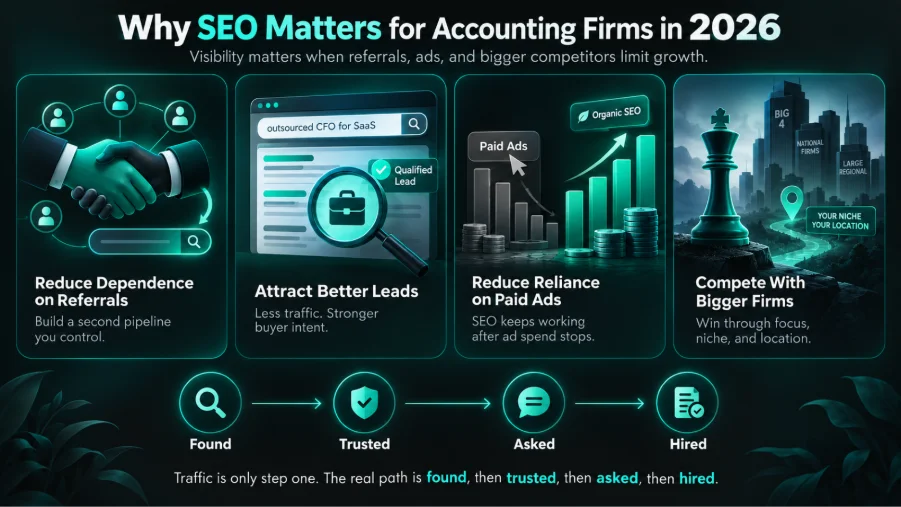
Most firms do not have a traffic problem. They have a predictable growth problem.
Referrals come in waves. One quarter is busy. The next is quiet. Paid ads fill the gap, but costs keep rising. And when people do land on your site, many want free tax answers.
Buying habits have changed too. Clients start on Google. They check Maps. They read reviews. Then some ask an AI tool to name a few firms. Bing feeds part of that. Your own site feeds the rest.
SEO for accountants fixes the front end of that journey. This guide shows what to do first, what to skip, and how to turn clicks into signed clients, drawing on the same approach behind our own SEO service built specifically for accountancy firms.
What Is SEO for Accountants?
Accountants SEO is a system, not a task. It links your site, your Google Business Profile, your content, and your name in the market. It blends a healthy website, strong service pages, local signals, expert content, and clear trust marks. The goal is not more traffic. The goal is more of the right enquiries, which is why our broader SEO services treat technical foundations, content, and local signals as one connected system rather than separate jobs.
How SEO Helps Accounting Firms Get Found
Someone types “tax accountant for landlords”. Google picks the best answer. Your job is to make that choice easy.
You need a page built for that one service. A real expert should write it. And it must sit on a site Google can read fast.
Why Accounting SEO Is Different from General SEO
Selling shoes is one thing. Handling someone’s tax bill is another.
Accounting SEO sits in what Google calls YMYL ground, short for Your Money or Your Life. Google judges content that can affect money more strictly, a challenge shared closely with the SEO work we do for financial services firms, where the same trust signals carry just as much weight.
Four things set SEO for accountants apart:
- Trust counts for more: Names, badges, and real firm details matter.
- Intent is local: Most searches name a town or say “near me”.
- Skill must be on show: Nobody hires an unnamed voice with their tax.
- Clients stay for years: One small win can pay off for years.
How People Search for Accountants Today
Service and Local Searches
Short and ready to buy:
- tax accountant
- accountant near me
- bookkeeping services
- outsourced CFO
Close to half of all Google searches have local intent. So, these often show the map pack first.
Industry and Problem-Based Searches
These show you the client behind the words:
- accountant for ecommerce companies
- contractor accountant
- switching accountants
- VAT help for small business
Conversational and AI Searches
More people now type full sentences. “My accountant keeps missing my deadlines, what should I do?”
Bright Local’s 2026 Local Consumer Review Survey found 45% of people now use ChatGPT or a similar tool to find local firms. That is up sharply from the year before. Not every buyer does this. Enough do that it belongs in your plan.
Long questions hand you gold. They reveal trade, problem, town, firm size, and goal in one line.
Build Your SEO Strategy Around Your Ideal Client
This is where most SEO for accounting firms goes wrong. It starts with volume, not value, a mistake we unpack further in our wider guide to digital marketing for accountants.
Identify Your Most Valuable Services
List every service. Mark the ones with strong margins, recurring fees, and work you enjoy.
Define Your Ideal Accounting Client
Turnover. Trade. Town. How messy their books are. What software they use.
Prioritize Keywords by Business Value
Score each keyword on six points:
| Factor | Ask yourself |
| Search demand | Does anyone search this? |
| Search intent | Are they buying or browsing? |
| Service profit | Is the margin worth it? |
| Client value | Will they stay for years? |
| Competition | Can you win here? |
| Conversion | Will this page bring enquiries? |
“Accounting software tips” might bring 5,000 visits and no clients. “R&D tax credit accountant” might bring 40 visits and one client worth five figures a year.
Low volume with high intent usually wins. Build your SEO marketing plan for accountants around that idea.
Keyword Research for Accountants
Good keyword research starts with understanding how potential clients search for accounting support. Most opportunities fall into five main groups:
- Service keywords: Focus on the services you offer, such as payroll services, company accounts, bookkeeping, and self-assessment help.
- Local keywords: Combine your services with the locations you serve. This could include searches like accountant near me, accountant in [city], or bookkeeping services in [location].
- Industry-specific keywords: Target the types of clients you want to attract, such as accountant for dentists, accountant for ecommerce businesses, contractor accountant, or accountant for freelancers.
- Problem-based keywords: Reach people searching for help with a specific issue, such as late filing penalty help, tax return mistakes, or how to change accountants.
- Long-tail questions: Target detailed searches such as how much does an accountant cost for a limited company? or when should a small business hire an accountant?
The important part is matching each keyword to the right search intent. People ready to hire usually need a service page. Informational searches work better as blogs or guides. Comparison searches may need dedicated comparison content.
Avoid creating several pages around the same intent. When multiple pages compete for the same keyword and purpose, they can weaken each other’s ranking potential. A better approach is simple: one clear search intent, one strong page.
Build an SEO Friendly Accounting Website Structure
A clean layout helps both Google and buyers:
- Homepage
- One page per core service
- Trade or sector pages
- Real location pages
- Team and author profiles
- Case studies
- Guides hub
A structure like this depends on solid foundations, which is exactly what our website development work is built to support before any content or SEO layer goes on top.
Why Each Core Service Needs Its Own Page
One “Our Services” page listing twelve services won’t rank well for any of them.
Through 2026, study after study puts a page per service near the top of local ranking signals for expert firms. Give payroll a page. Give VAT a page.
Each page should say what the job is, who it suits, what it roughly costs, what happens next, and who does the work.
When to Create Trade and Location Pages
Build a town page only if you truly serve that town. Real clients there. Real detail. Real staff.
Avoid thin pages, copied city pages, and doorway pages where only the town name changes. Google filters them. Buyers see through them too.
Local SEO for Accountants
For most firms, this pays back the fastest.
Optimize Your Google Business Profile
Your main category is the single biggest map pack factor in White spark’s ranking study. Pick it with care.
Then fill in the rest:
- Full list of services
- Correct phone, address, and hours
- A link to a page that matches the search
- Real photos of the office and team
- A booking or enquiry button where it fits
Improve Google Maps Visibility
Google weighs three things; relevance, distance, and standing.
You cannot move your office. You can lift relevance with better categories and page content. You can lift your standing with reviews, listings, and links.
Build Reviews and Local Trust
Reviews shift both rankings and minds. Bright Local’s 2026 survey found that about 97% of people read reviews for local firms. Many rule out anyone under four stars.
Four steps that work:
- Ask each happy client at a natural moment, such as at year-end sign-off.
- Reply to every review, good or bad, in a calm tone.
- Keep your name, address, and phone the same everywhere online.
- Claim your key listings and your membership body profile.
Claim Bing Places as well. It takes an hour and feeds Microsoft tools.
Content SEO for Accounting Firms
A blog every two weeks is not a plan. Answering buying questions is.
- Bottom-of-funnel content speaks to people ready to act. Fees, service comparisons, and how you onboard.
- Comparison content settles choices. Sole trader or limited company. In-house bookkeeper or outsourced.
- Teaching content builds standing and earns AI mentions.
- Seasonal content catches deadline rush. Plan it months out, not the week before.
Group it all into clusters. Here is one:
- Core service page: Outsourced CFO
- Support: CFO versus accountant
- Support: when to hire a CFO
- Support: fractional CFO costs
- Support: outsourced CFO for SaaS firms
Every support piece links up to the service page. The service page links back down. That is how topic strength forms.
E-E-A-T and YMYL for Accounting Websites
Google judges Experience, Expertise, Authority, and Trust more strictly on money topics.
Strengthen yours with:
- Named authors with real badges and photos
- A qualified reviewer signing off tax pieces
- Links to the tax office or regulator
- Real hands-on detail, told honestly.
- Case studies shared with consent.
- A visible address, phone, and firm number
- Clear written and updated dates.
- Membership bodies shown on the site
One risk deserves a flag. Old tax content is worse than none. Rates move. Thresholds move. Dates move. A 2023 figure still live tells readers nobody minds the shop.
Set a review date each year. Diarise it like a filing deadline.
Technical SEO for Accounting Firms
You do not need to code. You do need these checks.
- Crawling and indexing: If Google cannot reach a page, nothing else counts. Check coverage in Search Console each month.
- Sitemaps and canonicals: The sitemap lists what you want indexed. Canonicals tell Google which version of a page is the real one.
- Internal links: Links pass weight and guide readers. A page with no links pointing to it rarely ranks.
- Mobile and speed: Most local searches happen on phones. A slow form loses clients in silence.
- Core Web Vitals: These score loading, response, and layout shift. Treat them as a comfort score, not a magic lever.
- HTTPS, broken links, redirects: A security warning kills trust at a glance. Broken links waste crawls and annoy buyers.
Structured Data for Accounting Websites
Structured data is code that tells search engines what your page is.
Useful types for accounting firm SEO:
- Organization for firm details
- Local Business or a fitting service type
- Person for team and author pages
- Breadcrumb for site paths
- Article for blogs
It helps machines read you. It does not promise rankings. And no special “AI schema” promises a spot in AI answers. Be wary of anyone who says it does.
Link Building and Authority for Accountants
Relevance beats volume every time.
Safe routes:
- Membership body and trade listings
- Local chambers, charities, and sponsorships
- Press comment on tax changes
- Quotes for reporters
- Trade magazines
- Partner firms such as solicitors
- Useful tools, such as a fee or tax calculator
Skip bulk link deals, junk directories, link farms, and anything sold by the hundred. Cheap links buy you cleanup work later, and if you’re unsure whether a provider is cutting corners here, our guide on choosing the right SEO partner covers the warning signs to check for.
Why Accounting Websites Get Traffic but No Leads
This is the most common gripe in accountant SEO. The causes are usually short and fixable.
| Problem | Fix |
| Wrong intent | Build buying pages, not just guides |
| Broad reader traffic | Add trade and problem pages |
| Vague positioning | Say who you serve and what you charge |
| No trust marks | Add badges, reviews, real faces |
| Weak CTAs | Make the next step exact |
| Long forms | Cut to name, email, phone, need |
| Clunky mobile | Test your own form on a phone |
| Slow replies | Answer in hours, not days |
Conversion SEO for Accounting Firms
Rankings are the input. Enquiries are the output. Make each service page earn its keep with:
- A call to action tied to that one service
- A short form, plus tap to call on mobile
- Direct booking for a first chat
- Reviews from firms like theirs
- Badges and body memberships on view
- A short case study with real figures, where allowed
- A plain note on how onboarding works
- A guide price or a starting fee
- Light screening, so your time goes to the right people.
Traffic is never the final KPI. Signed clients are.
SEO for AI Overviews, AEO, and GEO
What Is AEO for Accountants?
AEO, or Answer Engine Optimization, helps search engines and AI tools extract clear answers from your content. Use question-based headings, answer directly, then add useful detail.
What Is GEO for Accounting Firms?
GEO, or Generative Engine Optimization, focuses on making your firm a trusted source that AI tools may reference or cite, which is the exact focus of our Generative Engine Optimization service.
For accountants, strong AEO and GEO usually depend on:
- Clear headings and direct answers
- Consistent business details
- Expert-led, accurate content
- Links to trusted official sources
- Fresh, regularly updated pages
- Mentions from reputable websites
The Role of Content in AI Search
Content is central to both AEO and GEO. Your website should answer real client questions, explain services clearly, and show genuine expertise.
Useful blogs, service pages, FAQs, guides, and expert insights give search engines and AI systems more context about your firm, services, locations, and specialist areas.
How Accounting Firms Can Improve Visibility in AI Search
Focus on strong fundamentals instead of platform-specific tricks. Keep your website accurate, maintain consistent business information, publish helpful original content, earn credible mentions, and build authority around the areas you know best.
No strategy can guarantee inclusion in AI-generated answers, but strong content and trusted signals can improve your chances.
How to Measure Accounting SEO Results
Split business results from vanity numbers.
Track these: organic enquiries, qualified leads, calls, booked meetings, proposals sent, signed clients, conversion rate, pipeline value, fees won, and client lifetime value.
Use these tools: Search Console for queries and indexing. GA4 for behavior and goals. Bing Webmaster Tools for Microsoft. Plus, any AI mention reports your tools offer.
Rankings, impressions, and authority scores explain movement. They do not pay wages.
How to Calculate SEO ROI for an Accounting Firm
The sum is simple.
SEO ROI = (Fees from SEO minus SEO cost) ÷ SEO cost × 100
The twist is retention. Accounting clients stay. If a client bills £3,000 a year and stays four years, that is £12,000 of value, not £3,000.
Judge SEO services for accountants on lifetime value. The maths often looks very different from a year-one view, especially once you weigh it against realistic digital marketing costs for UK SMEs.
Common SEO Mistakes Accounting Firms Should Avoid
- Chasing broad keywords only
- Counting traffic instead of qualified leads
- Cramming all services onto one page
- Publishing thin town pages
- Posting raw AI content with no review
- Skipping expert sign-off on tax topics.
- Neglecting the Google Business Profile
- Ignoring reviews
- Weak internal links
- Buying poor links
- Leaving old tax pages live.
- Ignoring Bing
- Ignoring AI-led discovery.
- Never tracking leads through to fees.
A 90-Day SEO Roadmap for Accounting Firms
Days 1 to 30: Audit and Fix the Base
Set up Search Console, GA4, and Bing Webmaster Tools. Run a crawl. Check what is indexed. Map keywords to pages. Review three rivals. Complete your Google Business Profile. Fix speed, broken links, and redirects.
Days 31 to 60: Improve SEO and Commercial Pages
Update key service pages around the right commercial keywords. Improve titles, headings, copy, internal links, and CTAs. Create niche and location pages only where there is real search demand.
Days 61 to 90: Build Content, Trust, and Authority
Publish useful content around target keywords, long-tail searches, and common client questions. Build topic clusters, strengthen internal linking, add answer-first sections, and earn relevant backlinks and mentions.
Track rankings, organic traffic, calls, and form submissions to see which keywords and pages drive results. Add expert profiles and make CTAs clearer and more persuasive.
Ninety days build momentum, but SEO growth continues through consistent content, optimization, and authority building.
Build an SEO Strategy That Brings the Right Accounting Clients
Flat rankings and traffic that does not turn into enquiries usually point to a deeper SEO problem.
At A8om, we help accounting firms find exactly that. We tie technical SEO, service pages, local search, conversion, and AI visibility to how your practice actually earns. We measure success in qualified enquiries, not impression charts.
If you want a clear view of what is holding your firm back in search, talk to our team at A8om. We will walk you through the approach that fits where your practice is right now.
Frequently Asked Questions
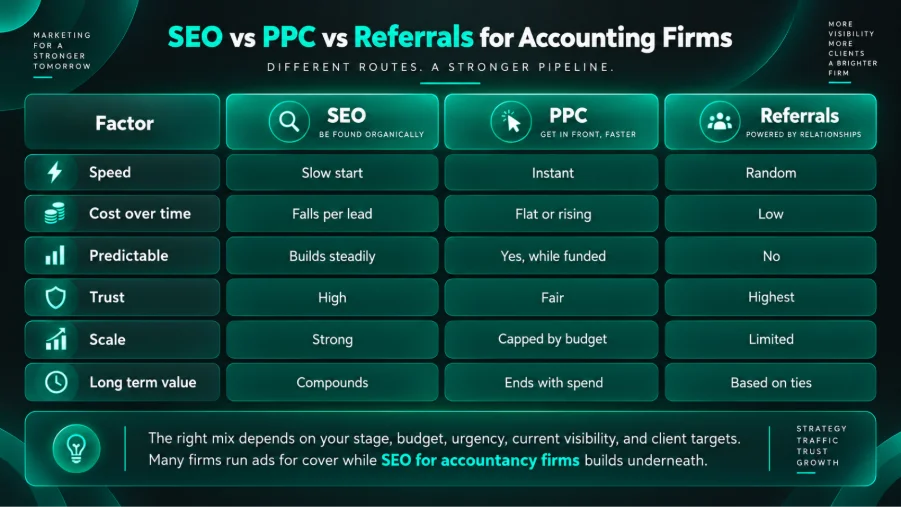
For most firms, yes. Clients pay monthly and stay for years, so one client from search can repay the cost many times over. SEO also cuts your reliance on referrals and ads. It suits firms with clear services, a defined client type, and patience for a six- to twelve-month build.
Focus on service terms, local terms, trade terms, and problem questions. Rank them by client value, not by volume. “Accountant for dentists” may get few searches but strong buyers. Broad words like “accounting” bring readers who rarely become clients.
Pick the right main category and fill in every profile field. Keep your name, address, and phone the same across the web. Gather real reviews steadily and reply to all of them. Back the profile with strong service pages. Distance from the searcher also counts and cannot be changed.
Yes, by being specific. National firms chase broad terms with big budgets. Smaller firms win on niches, trades, and towns where relevance beats size. A page written for shop owners in one city can outperform a generic national service page.
Should an Accounting Firm Hire an SEO Agency or Do SEO In-House?
In-house SEO can work if your firm has the time, skills, and resources to manage it consistently. An agency is often better when you need wider expertise and faster execution. A8om helps accounting firms with technical SEO, content, keywords, local search, and conversion, making it a strong option for firms that want structured, measurable growth.