Introduction:
Most creators hit a wall eventually. You’re posting daily, but the likes flatline, brands offer “gifted” collabs instead of cash, or you can’t get your followers to click the purchase link. It’s rarely a creativity issue; it’s a structural one. To shift from “person with a phone” to a scalable “media company,” you must stop treating social media like a lottery and start treating it as a strategic business. That means professional Social Media Marketing for Creators, focusing on the less glamorous but vital stuff: contracts, data, and distribution channels.
At A8om, we constantly see UK creators stall because their strategy fails to link their content directly to their bank account. This guide isn’t about hacks. It’s about the operational reality of running yourself as a business.
We’ll look at which platforms pay the bills, how to navigate UK advertising laws to avoid fines (including the disclosure standards referenced in Top Social Media Strategies for UK Businesses), and the exact frameworks we use to negotiate higher retainers for our roster.
What Social Media Marketing for Creators Means
Social Media Marketing for Creators is applying big business marketing principles to your personal brand. “Influencer marketing” typically means a brand hires you; this completely flips that script.
This is all about how you market as an influencer in the UK, the business, to attract those high-value contracts using a structured social media marketing system backed by clear positioning and consistent execution.
It goes beyond filming. It’s about knowing exactly who watches you and why. In the current UK market, marketing directors are obsessed with data. They don’t care about 100k followers if nobody clicks your links.
You must prove that you can drive measurable action, and that’s where a professional personal branding system and consistent social media marketing execution start to separate creators from hobby accounts.
We look at four pillars:
- Reach: Is the audience static, or are new, relevant people finding you?
- Trust: Do people believe in your recommendations, or do they enjoy entertainment? (Build the credibility layer properly, see How to Build Brand Authenticity on Social Media.)
- Conversions: Can you move people off the platform (e.g., onto an email list or shop page)?
- Retainers: Are you securing six-month contracts, or surviving on single one-off posts?
Case Study: A tech reviewer chased 100k views per video, but brands cited low sales conversions. We pivoted his strategy to detailed, less viral “comparison videos” (e.g., “iPhone vs Pixel for UK users”) as part of an integrated social media marketing approach, supported by tighter hooks and retention-focused video editing. His views dropped 40%, but his affiliate click-through rate tripled because the viewers who remained had much higher purchase intent.
Client Testimonial:
“My views went down, but my affiliate revenue doubled in month two. Quality views pay the rent, not just viral hits.”
—Davinder S., Birmingham (Tech)
The Influencer Marketing Process
Running your brand professionally requires a firm workflow. When we manage talent, we eliminate guesswork with clear deliverables, campaign structure, and weekly reporting, using the same build principles outlined in How to Create Effective Social Media Campaigns and applying them to creator partnerships. Deals typically collapse because the creator skips the strategy or, critically, the reporting, so the work must run like a client service backed by social media marketing services, not casual content creation.
- Audit & Positioning: Establish your current audience’s demographics and core performance metrics.
- Strategy Formulation: Define the ideal client. Are we pitching huge corporations or agile local startups? This is the core of your influencer marketing strategies.
- Production & Scheduling: Batch your content. Shooting daily guarantees burnout.
- Distribution & Engagement: Posting is only the beginning. Engage with comments for the first hour to maximize visibility.
- Outreach & Sales: Discovery is not a strategy. You must proactively pitch your value.
- Reporting & Optimization: The non-negotiable step. Send a transparent report after every campaign.
Case Study: A beauty creator often loses repeat business by ghosting the brand after posting. We introduced a mandatory “Day 30 Report” for every deal, highlighting saved posts, positive comments, and audience geography. This simple PDF addition turned one-off clients into quarterly partners.
Best Social Media Platforms for Creators in the UK
Choosing the best social media platforms for creators isn’t about what’s fun; it’s a cold, hard business decision. The UK market is currently segmented: LinkedIn is suddenly massive for B2B contracts, while TikTok still gives you the quickest shot at massive organic reach.
Your choice must directly align with your monetization model. Selling a £2,000 consulting package? LinkedIn delivers leads. Selling £20 makeup? You need Instagram and YouTube.

| Platform | Primary Function | Best For (Niche) | Monetization Path | UK Market Nuance |
|---|---|---|---|---|
| Portfolio & Community | Lifestyle, Fashion, Travel | Brand Partnerships, Affiliate | The “standard” CV for UK brands; a verified presence matters. | |
| TikTok | Discovery & Reach | Entertainment, Edutainment | Creator Fund (low), Volume Sales | Highly volatile; use primarily as a traffic source, not for core communities. |
| Authority & B2B | Business, Tech, Freelancers | Retainers, Consulting, B2B Ads | High organic reach in the UK currently; leads are exceptionally high value. | |
| YouTube | Trust & Depth | Tech Reviews, Education, Vlogs | AdSense, Deep Sponsorships | Hardest barrier to entry, but builds the strongest, most loyal long-term audience. |
Case Study:
We saw a fitness coach who was nowhere trying to sell his £200 coaching plans via short, high-energy TikTok. The content was fun, but it lacked authority. We totally shifted his primary focus to long-form education and YouTube Shorts, specifically targeting search terms like “home workouts for busy dads.” The quality of his leads absolutely skyrocketed because viewers were now spending 10 minutes with him, not just 10 seconds. That time investment builds deep trust.
How to Build a Personal Brand as an Influencer
Here’s the truth: Learning how to build a personal brand as an influencer means you must stop trying to be vaguely “famous” and start being fiercely, distinctly unique. You don’t need a huge following; you need a razor-sharp hook that makes you unforgettable.
The Positioning System: You need to nail your core identity. That means defining:
- Niche: “UK Mums” is too wide. “UK Mums starting businesses from their kitchen table” is a valuable, specific niche.
- Problem: What precise pain point do you solve for your audience?
- Promise: What can they expect from every post? What is your content guarantee?
- Proof: Why should they trust you over someone else?
The Brand System: Your feed cannot look inconsistent. Commit to one font set and one core editing style. We also push our creators to build a “Signature Series,” like “Marketing Mondays,” which trains the audience to show up at a specific time, just like a scheduled TV show, then reinforces it with a repeatable content engine supported by social media marketing, not sporadic posting.
Case Study:
Arjun, a finance creator, was posting generic savings tips and getting lost. We pivoted his entire brand to “The Freelancer’s CFO,” tackling niche UK tax issues like IR35 and VAT thresholds. His followers’ growth slowed, but his DMs filled with high-ticket consulting requests.
Influencer Marketing Strategies That Compound
- Effective influencer marketing strategies leverage work repeatedly. The goal is to work once and distribute widely.
- The “Hero Content” Waterfall: Produce one major piece (a YouTube video, a deep guide). Then slice it into 15 Tweets, 3 LinkedIn posts, and 5 Reels. Stop creating from scratch daily.
- Collaboration Ladders: Partner with creators only slightly ahead of you. Their audience trust transfers directly to your profile.
- Owned Audience Conversion: Social media rents land. Instagram could ban you tomorrow. You must get people onto a proprietary email list, built and automated properly through email marketing instead of hoping people “come back later.”
Case Study:
A food blogger had 100k followers but zero data ownership. We implemented a simple “Top 5 Winter Recipes” PDF lead magnet in her bio. She converted 5% of her audience to email subscribers in the first month, giving her a direct line to sell her cookbook later without worrying about the algorithm suppressing her posts.
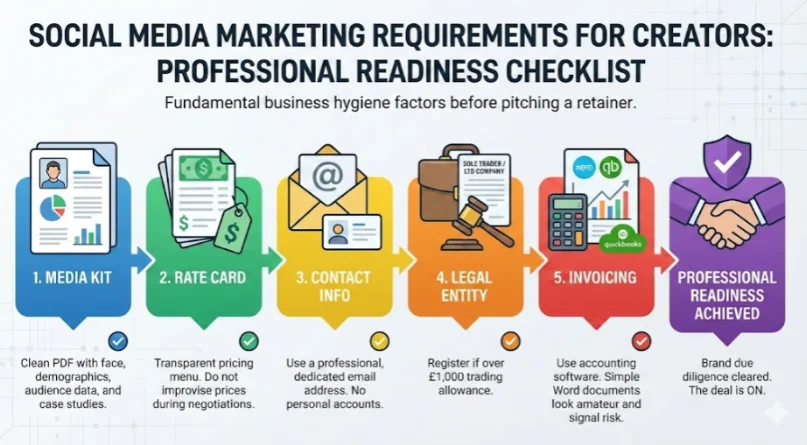
Social Media Marketing Requirements for Influencers
Before you pitch a retainer, you must look professional. If a brand conducts due diligence and finds disarray, the deal is off. Social media marketing requirements for influencers are your fundamental business hygiene factors.
The Professional Readiness Checklist is the absolute minimum standard for professional engagement. Think of it as your Social Media Marketing for Influencers Checklist.
- Media Kit: You need a clean PDF with your face, demographics, audience data, and case studies.
- Rate Card: Create a transparent pricing menu. You never want to improvise prices during negotiation.
- Contact Info: Use a professional, dedicated email address. No personal accounts are allowed.
- Legal Entity: If you clear the £1,000 trading allowance, you need to register as a Sole Trader or Ltd Company.
- Invoicing: Use proper accounting software, like Xero or QuickBooks. Sending a simple Word document invoice looks amateur and signals risk to a brand’s finance department.
Case Study: A travel creator lost a major hotel deal because he couldn’t quickly provide a compliant invoice. The brand’s finance team flagged him as a risk. We set him up on Xero and registered his Ltd company within 48 hours to professionalize his back office. He recovered the relationship by sending a compliant invoice the next day.
How to Market as an Influencer in the UK
You cannot afford to wait to be discovered.
The Outreach Pipeline:
- List Building: Identify 50 brands you genuinely align with and whose products you use.
- Qualification: Check out the Facebook Ad Library. If they are running paid campaigns, they have a budget for creators. (If you’re building a Facebook-first strategy alongside outreach, see How to Use Facebook to Benefit Your Business.)
- The Pitch: Stop saying, “I love your brand.” Start saying, “I saw you’re pushing Product X. I have an audience that needs exactly that.”
- Follow-up: Send a polite nudge after 3 days. Most deals close on the second or third email interaction.
Negotiation Basics: Stop selling just “posts.” Sell “usage rights.” If a brand wants to use your content in their paid ads (allowlisting), that commands a premium fee (often an uplift of +50% or more).
Case Study: A gaming creator sent 50 generic “Collab?” DMs to hardware brands and got zero replies. We switched to personalized email pitches that referenced specific campaigns the brands were currently running. This direct relevance got him a 15% response rate and closed a £5k deal with a peripheral brand.
Social Media Marketing Tools for Influencers
You need the right social media marketing tools for influencers to save time and prevent errors, especially when you’re running a repeatable content and reporting cadence like the one used in Top Social Media Strategies for UK Businesses.
- Planning: Later or Buffer. You must be able to plan your feed content visually.
- Scripting: Notion. Centralize your ideas, scripts, and asset tracking.
- Editing: CapCut. It is the industry standard for short-form videos.
- Approvals: Google Drive or Frame.io. Never send high-res video files over WhatsApp; the compression absolutely crushes the quality.
Social Media Marketing Costs for Influencers in the UK
So, what does all this cost? Social media marketing costs for influencers vary hugely based on how much work you outsource versus what you do yourself. Let’s break down the common monthly budgets:
| Tier | Monthly Cost (Est.) | Includes | Suitable For |
|---|---|---|---|
| DIY (Starter) | £50 – £150 | Software (Canva, Editor), Hosting, Domain | Micro-influencers (<10k followers). |
| Hybrid (Pro) | £500 – £1,500 | Part-time freelance Video Editor, Advanced Tools, Paid Ads (Self-promo) | Mid-tier influencers focused on revenue growth. |
| Full Service | £2,000 – £5,000+ | Agency or Manager, dedicated Editor, Photographer, PR tools | Macro-influencers or high-revenue creators. |
Macro-influencers or high-revenue creators (typically bundled into a full social media marketing delivery model).
Case Study: Jessica, a fashion creator, was editing everything herself and was capped at two reels a week. She hired a freelance editor for £500/month. Her output immediately doubled to four reels a week, and the improved consistency led to a 20% jump in revenue within the first month.
Influencer Marketing Timeline and How Long to See Results from Influencer Marketing
People always ask how long it takes to see results from influencer marketing. If you initiate a new strategy, patience is mandatory.
The influencer marketing timeline is typically a 90-day cycle to validate any major effort.
- Month 1: Foundations. Establish consistent posting and monitoring data.
- Month 2: Growth. Tweak your content hooks based on performance data. See the initial engagement lift.
- Month 3: Monetization. Use the solid data from months 1 and 2 to secure your first new retainer.
Case Study: Lucy, a comedy creator, wanted to quit after three weeks because her new format wasn’t instantly going viral. We convinced her to stick to the 90-day plan. In week 7, the algorithm finally picked up her “series” format, and she gained 10k followers in a single weekend.
Measuring Social Media Marketing ROI for Influencers
To get repeat business and higher rates, you must calculate social media marketing ROI for influencers. Vanity metrics are a dead end.
KPI Framework:
- Awareness: CPM (Cost Per Thousand views).
- Engagement: CPE (Cost Per Engagement).
- Action: CPA (Cost Per Acquisition/Sale).
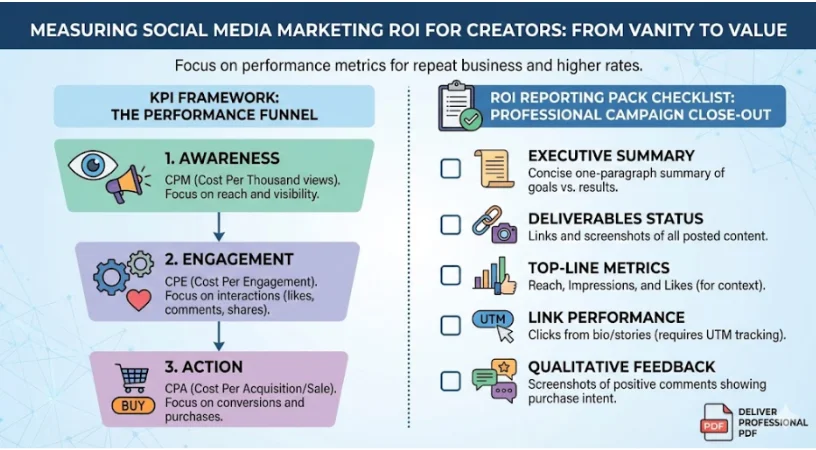
ROI Reporting Pack Checklist: When a campaign finishes, send a professional
PDF with: Executive Summary: A concise, one-paragraph summation of success or failure against goals.
Deliverables Status: Links and screenshots of all posts.
Top-line Metrics: Reach, Impressions, and Likes (for context).
Link Performance: Clicks on bio or stories (requires UTM tracking).
Qualitative Feedback: Screenshots of positive comments showing purchase or intent.
Case Study: Mark, a tech influencer, used to send screenshots of likes, which failed to prove value. We added UTM tracking to his bio link, allowing him to show brands exactly how many sales he generated. He used this data to negotiate a higher base rate for his next contract.
Risks of Social Media Marketing for Influencers
There are significant, unavoidable risks of social media marketing for influencers.
Risk Controls Checklist
- Platform: Shadow banning or Account Suspension. Mitigation: Diversify immediately to two platforms; build that email list (using proper email marketing).
- Commercial: Non-payment or “Ghosting” by brands. Mitigation: Use an iron-clad contract; require a 50% deposit upfront.
- Reputation: Backlash from a tone-deaf partnership. Mitigation: Vet brands strictly against your values; never promote what you haven’t tested.
- Legal: ASA Investigation for undisclosed ads. Mitigation: Clearly label content (see next section).
Case Study: Holly, a lifestyle creator, lost access to her Instagram account for a week due to a hacking attempt. Because she had built a newsletter, she was able to email her followers immediately, retaining 40% of her daily traffic and continuing to sell digital products while the account was down.
Legal Requirements for Influencers in the UK and Compliance Issues
The legal requirements are strictly enforced by the ASA (Advertising Standards Authority) and CMA in the UK.
- Disclosure: You must place #Ad or “Paid Partnership” at the very START of the caption/description. Not at the end. Never hidden in comments.
- Gifts: If you post a gifted item and the brand had any editorial influence (e.g., they asked you to), it must be disclosed.
- Tax: (Disclaimer: Not financial advice). If you earn over the £1,000 trading allowance, you need to inform HMRC. Keep detailed receipts for all business expenses.
Case Study: Nina, a beauty blogger, was flagged by the ASA for burying her disclosure hashtags in the “more” section of her captions. We audited her feed and implemented a strict “Ad first” policy where disclosures appear immediately. Brands actually preferred this transparency as it reduced their own compliance risk.

How to Create an Influencer Social Media Campaign in the UK
When you launch your own influencer social media campaigns, a firm structure is vital. This is crucial for influencer marketing campaign best practices.
- Creative Brief: Define the core “hook.” What is the single takeaway you want people to remember?
- Production: Script, shoot, and edit. Remember: good audio is more important than good video.
- Approvals: Factor in 3–5 days for brand review, if applicable.
- Launch & Community Management: Post, then manage. Reply to every comment for the first 60 minutes.
- Retargeting: Post a story 24 hours later to drive fresh traffic to the main feed post.
Case Study: Ben, a gaming creator, was launching a limited-edition merch line. Instead of just posting the link on launch day, we built a two-week teaser campaign using countdown stories and behind-the-scenes design videos. The anticipation resulted in a complete sell-out within 24 hours of the store’s opening.
Client Testimonial:
“The build-up was everything. I sold out before I even posted the link.
” —Ben J., Liverpool (Gaming)
Influencer Marketing Agency Cost & Working with a Manager
If you hire one of the best influencer marketing agencies in the UK, understand the difference between “talent management” (who works for you) and “marketing agencies” (who work for brands). The influencer marketing agency cost is usually a commission.
Working with a talent management agency involves:
- Discovery: They audit your channel to see if you are “sellable.”
- Strategy: They will tell you to fix your content to attract better advertisers.
- The Cut: Standard UK commission is 20% on all deals they broker for you.
- Firewall: They handle the negotiation, legal, and contracts, saving you the headache.
It varies wildly. You can spend £50/month on basic tools like Canva, or £2,000+ if you hire full-service management. Your highest costs will eventually be equipment, software, and outsourcing your editing.
Pick a niche and solve a clear problem for that audience. Create a professional media kit. Then, pitch brands actively. Consistency and engagement are your biggest assets.
Instagram remains the portfolio standard. TikTok is for organic reach. LinkedIn is the hidden gem for high-value B2B deals. YouTube builds long-term trust and AdSense revenue.
Give it 90 days. Month 1 is building, Month 2 is growing, and Month 3 is monetizing. If you quit in week 3, you lose.
Shadow banning, unstable income, and reputational damage. Mitigate these by building an email list and using strict contracts.
Follow ASA guidelines. Label ads with #Ad upfront. Declare your income to HMRC if you make over £1,000.
Set a clear goal. Define the deliverables. Produce high-quality content. Ensure legal disclosure. Report on the hard metrics afterwards.
Buying followers, inconsistent pricing, ignoring the brand’s creative brief, and signing poor contracts that give away usage rights for free.
Focus on Engagement Rate, CTR (Click Through Rate), and CPA (Cost Per Acquisition). “Likes” are irrelevant to revenue.
Cap Cut for editing. Canva for graphics. Later or Buffer for scheduling. Notion for centralized planning.
Reply to comments immediately after posting. Use interactive stickers and polls. Use stories to engage authentically, not sales pitches.
They audit you, sign you (usually exclusively), build a strategy, and then pitch you to their brand contacts. They handle the negotiation and paperwork for a commission.
Yes. ASA rules on ad disclosure are the most critical. Be cautious with specific sectors like finance, gambling, and alcohol.
Specific positioning, publishing consistency, platform diversity, community management, and professional business backend.
Conclusion
Mastering social media marketing for creators means changing your mindset from “content creator” to “media company.” You need creative consistency, strategic positioning, and operational discipline.
Start by checking your current setup against the checklists here. Fix your legal requirements for influencers in UK compliance, create your rate card, and start reporting properly.
If you want A8om to apply this framework to your profile, we can run a focused influencer audit and deliver a 90-day roadmap, outreach assets, and a reporting pack you can use immediately.
Book a free strategy call and leave with clear priorities, measurable targets, and a repeatable system for consistent brand deals.