What Are Demand Gen Campaigns?
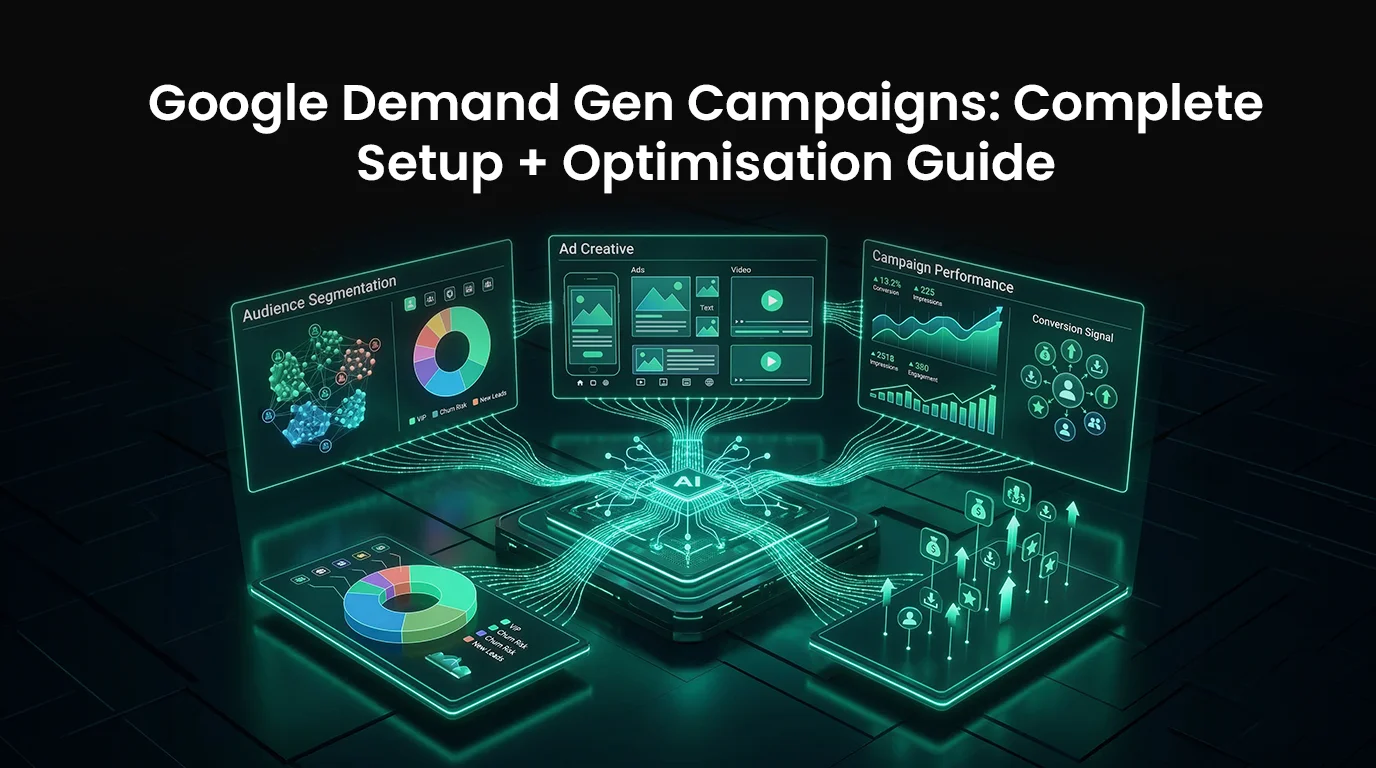
Digital marketing has changed a lot. You need to know how people find brands today. Demand Gen campaigns are Google’s AI-powered ad tool. They show your ads on YouTube, Google Discover, and Gmail. Search ads wait. Users type a query first. Demand Gen is different. It finds your customers before they search. Google predicts who will want your product. These people have not searched yet. But they fit the profile. This is a big shift. You stop waiting for searches. You build demand first. You create interest before people know they need you.
Why Does Google Demand Gen Matter in 2026?
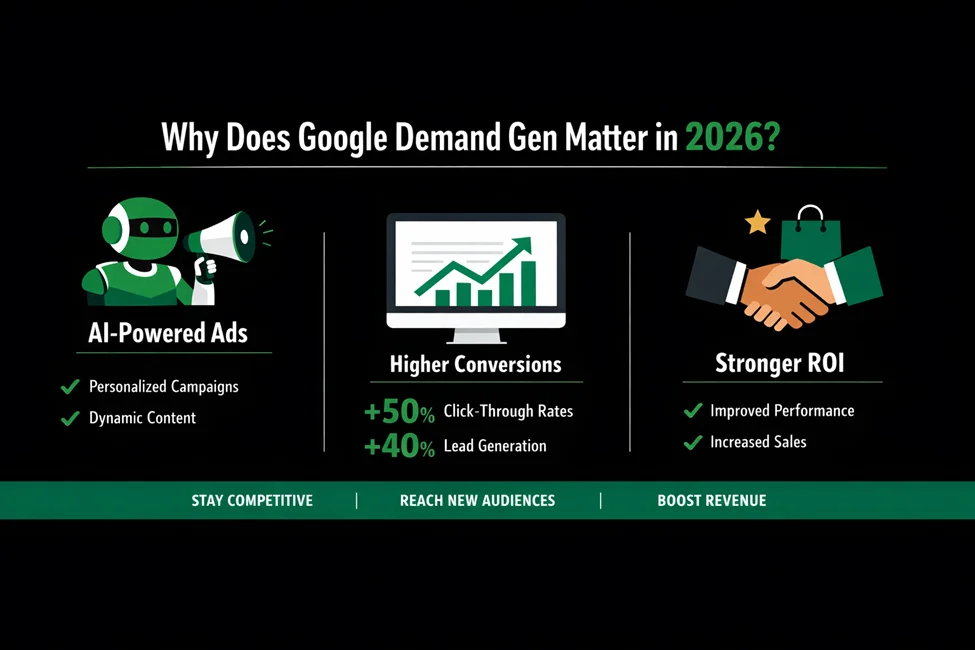
Buying journeys are now visual. The path from awareness to purchase has changed. We call this the “messy middle.” Cookies are dying. So, Google uses first-party data and AI. These tools predict what users want. This helps you scale. You find new customers like your best ones. They are watching YouTube now and or scrolling Discover. Automation is standard now. Your edge is good creative. AI handles the rest.
Who Should Read This Guide?
This guide goes deep. It is for people who manage large ad budgets. You need results. You might be a B2B marketing director. You want shorter sales cycles. Or you own an online store. You need to stand out. Maybe you work at a performance marketing agency that must deliver ROI in a post-cookie world. These strategies work for all businesses. You will learn to drive steady growth.
What Are Demand Gen Campaigns?
Definition and How They Work
Demand gen campaigns tell visual stories. They work at the top of your funnel. They build interest. The system uses two main tools. Interest targeting and lookalike segments. You upload images and videos. Google’s AI studies them. It looks at colors, objects, and themes. Then it finds users who like those things. Here is how it works. A user watches car reviews on YouTube. They read tech news on Discover. The AI spots this pattern. It marks them as a good prospect for electric cars.
The system builds a journey. The user sees a video on Shorts. Later, an ad appears in Gmail. This is how multi-touch works.
How Demand Gen Differs from Other Campaigns
You need to know the differences. This helps you spend wisely. The biggest comparison is demand gen vs search ads. Search is reactive. It catches ready people. Someone searches “best cloud software.” They have a problem now. Demand Gen is proactive. It finds the accountant who is not searching. Their current system is slow. They are frustrated. But they have not looked for help yet. You reach them early. This often costs less than Search. Performance Max also uses AI. But it is different. P-Max finds conversions anywhere. It likes Search and Shopping. Demand Gen focuses on visual platforms. You get more control. You choose where ads show. Many brands use both. PPC campaigns like P-Max maintain baseline conversions. Demand Gen builds your brand.
Why Is Google Promoting Demand Gen?
Google built this for today’s users. Short videos are huge now. TikTok started this trend. People discover brands through quick videos. YouTube Shorts taps into this. Google keeps it in its ecosystem. AI enables smart testing. The system tries thousands of ad versions. It finds which headline works best. Which image gets clicks? Which call-to-action converts? This was impossible five years ago. Now it is standard.
What Are the Benefits of Demand Gen Campaigns?
Expanded Reach Across Google’s Visual Inventory
The top benefit is reach. You access 3 billion users each month. They are on YouTube, Discover, and Gmail. These ads are native. They look like regular content. In Discover, your ad looks like news. In Gmail, it is a promotion. On YouTube, it is part of the feed. Users are in discovery mode. They are open to new ideas. They are more receptive now than when doing tasks.
AI-Powered Optimization and Personalized Audiences
The AI does more than manage bids. It understands your creative. It sees objects in images. It reads moods in videos. It identifies themes. Then it shows ads to the right people. Users get personalized content. You spend less time testing. The AI finds which audiences like which videos. You cannot match this manually. Not on scale.
Lookalike Audiences for Scaling Reach
This is the most powerful tool. Lookalike segments scale your reach. You upload customer data. Your best buyers. Your engaged users. This is the seed. Google scans all users. It finds people like your customers. Similar age, interests, and behaviors. This beats broad targeting. It is based on your real data. You scale with confidence.
Brand Awareness and Mid-Funnel Influence
Most marketers focus on final clicks. Demand Gen works differently. It builds brand awareness. This helps your other campaigns. Someone sees your Demand Gen ad. They do not click now. But they remember you. Later, they search for your product. They are more likely to click your Search ad. This is an assisted conversion. It is critical. Many marketers miss this value.
Demand Gen Campaign Types & Specs
Campaign Objective Options
Your objective shapes how AI works. There are three main choices: conversions, Conversion Value, and Clicks. Conversions find leads or sales. You set a target CPA. Conversion Value maximizes revenue. This works for varied pricing. Use it if products have different values. Maximize Clicks gets volume. Use this early. Gather data first. Then switch to conversions.
Creative Formats and Recommended Specs
Success is 70% creative. Only 30% is the technical setup. The demand gen campaign specs need variety. Your ad must fit everywhere. Provide single images. Use three sizes. Landscape (1.91:1). Square (1:1). Portrait (4:5). For carousels, use up to 10 cards. Great for product lines. Good for brand stories. Video is required. Include horizontal videos for YouTube. Add vertical videos for Shorts. Use a 9:16 ratio. Include high-quality logos. Write short, clear headlines. If you need help creating high-quality video assets, professional video editing services can ensure your content stands out and captures attention in the first 3 seconds.
Placement Channels and Asset Strategy
The campaign is smart about placement. Vertical video works on mobile Shorts. Image carousels work in desktop Gmail. Your assets should match each platform. Use native-style content. Short videos should look casual. Like phone footage. Use professional photos for Discover. This hybrid approach works. Your brand fits each environment.
Demand Gen vs Other Campaign Types
Demand Gen vs Search Ads
The key difference is the intent stage. Search ads harvest demand. They catch ready buyers. But keyword costs are high now. Record highs in 2026. Demand Gen sows demand. It targets pre-intent users. They are not searching yet. But they have buyer traits. You reach them early. This often costs less than Search alone.
Demand Gen vs Performance Max
Both use AI. But the scope differs. Performance Max seeks conversions anywhere. It favors Search and Shopping. Demand Gen is visual-focused. You control placement more. Use Demand Gen for brand guidelines. For premium YouTube content. Many brands use both. P-Max for baseline efficiency. Demand Gen for growth.
Demand Gen vs Display and Video Campaigns
Display ads create banner blindness. People ignore them. Demand Gen is different. It uses high-engagement feeds. Users pay attention here. Standard video campaigns use only YouTube. Demand Gen adds Discover and Gmail. It is more versatile. Better for multi-channel stories.
How Do You Set Up a Demand Gen Campaign?
Initial Setup Steps
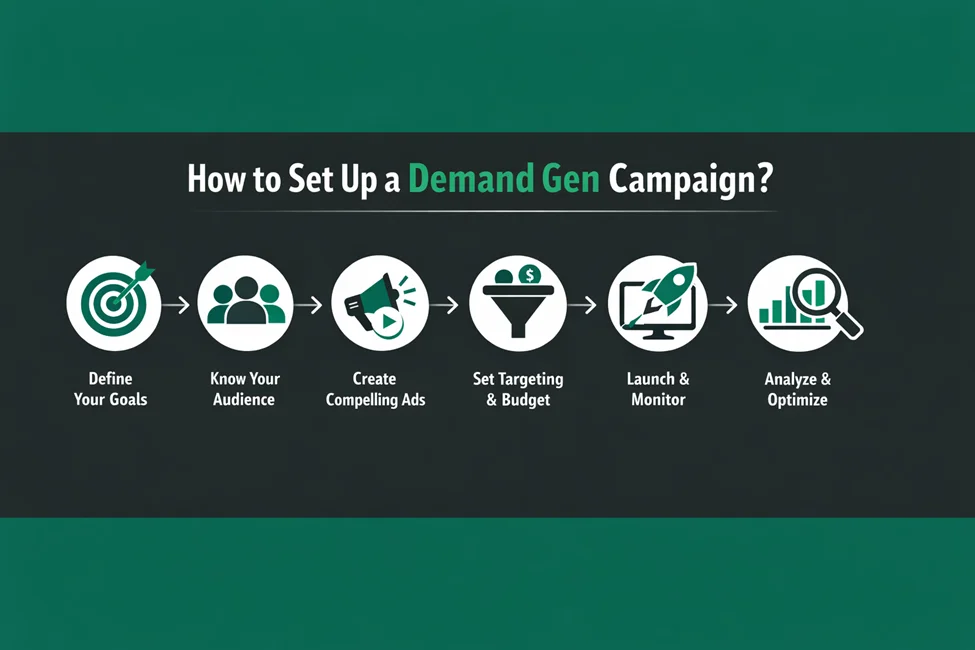
Log in to Google Ads. Click the plus button. Choose “Leads” or “Sales” as your goal. Select “Demand Gen” as campaign type. Set your budget next. Choose your bidding strategy. Start with 15-20 times your target CPA. This helps AI learn faster. Most people choose “Maximize Conversions” with target CPA.
Audience Configuration
Define your audience now. Upload first-party data if you have it. Customer lists work well. Website visitors, too. People who watched your videos. Create lookalike segments next. A 2% lookalike is precise. A 5% lookalike is broader. Start small for quality. Expand as you learn. Add interest targeting too. Pick relevant categories. Do not go too narrow. AI needs room to find patterns.
Creative Upload and Asset Groups
Upload all creative assets now. Include 3-5 images. Use different sizes. Add 2-3 videos minimum. Include one vertical video for Shorts. Write 3-5 headlines. Make them clear. Focus on benefits. Add 3-5 descriptions. Expand your value here. Include a strong call-to-action. Tell users what to do. The system tests combinations. More variety helps. AI finds what works best.
Conversion Tracking Setup
Check your tracking before launch. Set up Google Analytics 4. Create conversion actions. Track what matters to you. Form submissions. Purchases. Phone calls. App downloads. Use Google Tag Assistant. Confirm tags fire correctly. Test a conversion yourself. Make sure it appears in Google Ads. Good tracking is critical. It teaches AI what success looks like.
How to Optimize Google Demand Gen Campaigns
Creative Optimization: The Primary Lever
Creative is the new targeting. Algorithms run everything now. Test new hooks constantly. Try new visual styles. Review assets weekly. Find your bottom 20%. Replace them with new ones. For the video, change the first 3 seconds. Users decide quickly here. Stay or skip. For images, test color palettes. Try lifestyle shots. Try product-focused shots. Avoid creative fatigue. Even great ads stop working. Audiences see them too much.
Audience and Targeting Optimization
Refine segments as you grow. Check audience insights. See which demographics work best. Your 5% lookalike might beat 2%. It gives AI more room. It finds outliers. Use custom segments too. Target competitor visitors. This conquering works well. Pair it with a strong USP in ads.
Budget and Bidding Tips
Budget fuels the AI. Too little causes problems. Set a daily budget at 15-20 times the target CPA. This lets the system learn. It generates enough conversions. Adjust bids carefully. Change the CPA or the ROAS slowly. Do not change more than 20% at once. Big changes reset learning. This hurts performance.
Landing Page Optimization
Your ad is only part of the journey. The landing page matters too. Match the ad’s energy. Shorts video is high-energy? The page should be too.
Mobile-first design is required. 2026 demands this. Keep forms short. Make CTAs clear and big. Show social proof immediately. Reviews and testimonials. No scrolling needed. Less friction means more conversions. If you need help building high-converting landing pages, professional web design services can ensure your pages load in under 2 seconds and are optimized for mobile conversions.
Measurement and Reporting
Know your real ROI. Use Google demand gen reporting tools. Check view-through conversions. These are important. People see your ad. They do not click. But they convert later through other channels.
Last-click data misleads you. You will think Demand Gen fails. But it is driving growth. Use GA4’s model comparison. See full journey impact. Not just final clicks.
What Are the Risks of Demand Gen Campaigns?
One big demand gen campaign risk is wrong expectations. Many treat it like Search. They want instant leads with high intent. But Demand Gen targets the early funnel. Sales cycles are longer. Be patient. Under-budgeting is common. £10 daily will not work, not in competitive industries. AI cannot learn from this. Performance spirals down, poor creative kills campaigns. Generic stock photos fail. It is 2026 now. Users are smart. They scroll past obvious ads. Data discrepancies confuse people. GA4 and Google Ads differ. Google Ads tracks impression time. GA4 tracks conversion time. Know this difference. Do not make rash decisions.
Advanced Tips & Hidden Insights
Dealing with Data Discrepancies
Privacy rules create modeled conversions. Google uses AI to fill gaps. Users opt out of tracking. Your CRM will not match Google Ads exactly.
Accept directional accuracy. Stop chasing perfect numbers. Watch trends instead. Google Ads shows 20% more conversions? CRM shows a similar lift? The campaign works. Exact numbers do not need to match.
Demand Gen for Remarketing Success
Demand Gen excels at retargeting and not just prospecting. Show stunning video to cart abandoners. This beats static banners easily. Best strategy in 2026? Sequential messaging. Show product demo first. Then customer testimonials. Finally, a limited-time discount in Gmail. Variety keeps a brand fresh. Conversion probability rises.
Search Lift and Indirect Performance
True power shows in brand searches. Good Demand Gen campaigns create search lift. More people search for your company name. This proves visual ads work. They build mental availability. Use Google’s Search Lift Tool. Measure this scientifically. Get hard proof. Show stakeholders why top-funnel spend works.
Demand Gen Campaign Examples & Case Studies
Example: B2B Lead Generation Workflow
Sterling Ledger is a London FinTech firm. They struggled with high CPL. The search alone was not working. Keywords cost £45 per click. Growth had stopped. We launched a b2b demand gen campaign. We targeted CFOs and Finance Directors. We used 5% lookalike segments. Based on high-value clients. We deployed vertical videos for YouTube Shorts. Results were strong. Brand search lift increased 42%. CPA dropped 30% versus Search. View-through conversions rose 15%. They were not reliant on Search auctions anymore.
“Working with Demand Gen changed our perspective. We were not just buying clicks. We were building a pipeline. Prospects felt they knew us before visiting our site. It’s been our biggest driver of qualified leads this year.” Marcus Thorne, CMO at Sterling Ledger.
What Is the Google Demand Gen Timeline?
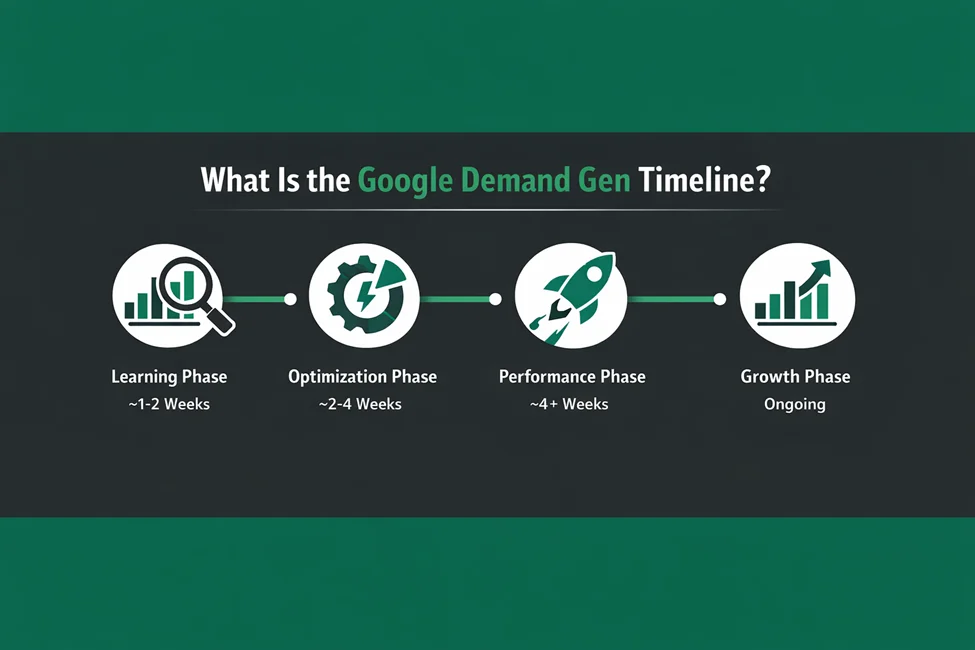
Phase 1: The Learning Phase (Weeks 1–2)
This is the black box period. Google AI experiments. It tests placements. It tries audience combinations. Your CPA might be high now. Results feel inconsistent. Keep your budget steady. Do not change creative. Do not adjust targeting. The algorithm buys data. It learns your audience.
Phase 2: Calibration & Optimization (Weeks 3–4)
Week three brings stability. The system has enough data. You can trim now. Remove bad assets. High spend, zero conversions? Cut them. Adjust bids by 5-10%. Push for better efficiency. The campaign shifts from expense to asset.
Phase 3: Long-term Scaling (Month 2+)
You have a stable, profitable CPA now. Start scaling. Increase the budget 20% weekly only if efficiency holds. Add new creative concepts now. Prevent fatigue. Scaling is a marathon. Not a sprint. Use a disciplined approach. Let data guide you.
Google Demand Gen Reporting Tools
Master the Report Editor in Google Ads. Basic columns are not enough. CTR and CPC are just the start. Create custom columns. Add view-through conversions. Add engaged-view conversions. These show video performance better. Check your integrating demand gen with CRM. Is it working? Pass conversion data back from Salesforce or HubSpot to Google Ads. Train AI on qualified leads. On closed deals. Not just form fills. This is a huge edge in 2026. For seamless CRM integration with your campaigns, Zoho CRM implementation services can help you track the full customer journey from first touch to closed deal.
B2B Demand Gen Campaigns
How Do B2B Campaigns Differ from B2C?
B2B demand gen campaigns need a different psychology. B2C is simple. Someone buys shoes after one ad. B2B is complex. You target buying committees. Five to ten people. Your creative addresses different pain points. Different stakeholders care about different things. CFOs want ROI. Managers want ease of use. Demand Gen lets you target both. Run multiple ad groups. Different personas each.
Targeting Long Sales Cycles and ABM
Sales cycles are long six to twelve months. Demand Gen is perfect for nurturing. Use it with Account-Based Marketing (ABM). Upload target account lists. Your ads reach those company employees. This creates surround sound. Your brand appears everywhere to your most important prospects. Sales outreach becomes easier. More effective.
How A8OM Can Help (According to This Guide)
Google’s AI landscape is complex. A8OM makes it simple. We provide strategy and technical expertise. We turn campaigns into growth engines.
We help with everything. Funnel mapping. Objective setting. Creative asset production. High-conversion assets. Our team handles technical integration. For 2026 success. Your CRM aligns with ad spend. Your analytics, too. We provide monthly optimization—transparent reporting. We focus on what matters. Revenue and lead quality. Need full setup and launch? Need a performance audit? A8OM is your Demand Gen partner.
Our PPC management services include comprehensive Demand Gen campaign setup, from initial strategy to ongoing optimization. We have helped businesses across the UK reduce their CPA by 30% or more while scaling their reach through intelligent use of lookalike audiences and creative testing. If you are ready to move beyond traditional Search advertising and tap into proactive demand generation, book a free strategy call with our team. We will audit your current paid advertising setup and show you exactly how Demand Gen can complement your existing campaigns.
Frequently Asked Questions
For UK businesses, Google Demand Gen shifts advertising from passive to active. The UK market is competitive. Search CPCs are very high among the highest globally. Demand Gen offers an alternative. Reach customers on YouTube and Discover at a lower cost.
To set up a Google Demand Gen setup in the UK, log in to Google Ads. Create a new campaign. Choose “Leads” or “Sales” as a goal. Select “Demand Gen” as type.
The best option for UK markets is lookalike segments. Upload your UK customer list. First-party data works best. Google finds millions of similar users across the country.
Optimize demand gen campaigns through assets and audiences. UK consumer trends change fast. Review asset reporting weekly. If you need support with campaign optimization, A8OM’s PPC specialists provide hands-on management and monthly performance reviews focused on reducing wasted spend and improving conversion rates.
This confuses many people. Google Demand Gen is part of Google Ads. “Google Ads” includes Search, Shopping, and Display. Demand Gen is a sub-category. It focuses on visual, AI-driven discovery.
Look beyond last-click metrics. Monitor view-through conversions. These track users who saw your ad. Then converted via another channel later.
What budget should I allocate for Google Demand Gen campaigns in the UK?
For success, budget matters. We recommend 15 to 20 times your target CPA. Daily. In the UK market, target a £20 cost-per-lead? Spend £300–£400 per day. This gives AI enough data to learn.
Yes. Demand Gen works great for retargeting. Target UK visitors who engaged but did not convert. Create a website visitors segment in Audience Manager. Serve them immersive video and carousel ads across YouTube and Gmail.
Customer acquisition uses lookalike features. Upload your top 1,000 UK clients’ highest-value ones. Create a 2% lookalike segment. This targets the 2% of UK users. Most similar to your best customers.
GDPR compliance is critical. For UK campaigns. Using first-party data for lookalikes? Ensure data collection is transparent. Get explicit consent from users. To use their data for ads.
The biggest mistake is wrong expectations. Treating Demand Gen like Search. Expecting instant results. High volumes of last-click conversions. Many shut down too early. Another pitfall is generic stock images. British consumers want authenticity.
How can I improve conversion rates in Google Demand Gen campaigns?
Focus on frictionless journeys. Mobile pages must load in under 2 seconds. UK users are impatient. Slow content loses them.
Conclusion
Google Demand Gen campaigns changed the game for digital advertisers in 2026. You move beyond capturing intent. You create demand proactively. Businesses achieve new scale. New efficiency. This was impossible before. Success needs more than a technical setup. You need a creative-first mindset. A data-driven approach to audiences. And patience. Let AI optimize for long-term growth. The digital landscape keeps evolving. What works today becomes baseline tomorrow. Stay at the forefront. Use these visual and AI-powered tools. Position your brand for lasting success in a world where attention is the most valuable currency. Whether you are managing campaigns in-house or working with a digital marketing agency, the principles in this guide will help you unlock the full potential of Google’s Demand Gen platform. From social media marketing integration to advanced audience targeting, every element works together to create a comprehensive demand generation system that drives real business growth.