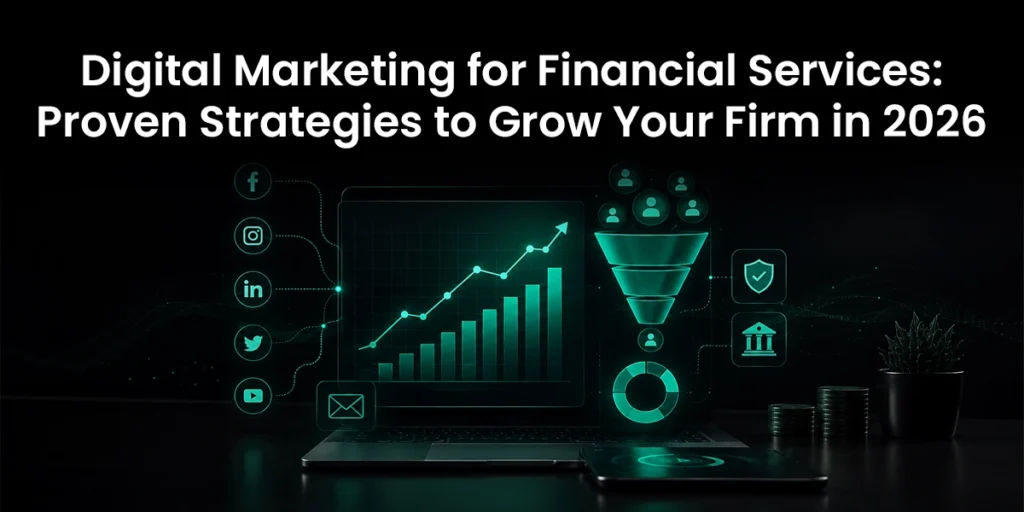
Money decisions used to start with a phone call. Now they start with a search bar or a chatbot. This shift has changed how banks, fintechs, advisors, and insurers win new clients. People research loans at midnight. They compare advisors before breakfast. Many ask ChatGPT to explain a mortgage term before they call a human.
AI search has joined Google as a place where money decisions begin. Trust still matters most in finance. But trust now gets built, or lost, on a website or in a short video, long before anyone picks up the phone.
This guide covers what works in digital marketing for financial services in 2026. You will learn how to build trust online, rank in AI search, and pick the right marketing partner for your firm.
What Is Digital Marketing for Financial Services?
Digital marketing for financial services is an approach that uses SEO, content marketing, ads, email marketing, and social media to get and convert clients. This works for banks, fintechs, wealth management companies, insurance, mortgage lending, and accounting organizations. It is a combination of excellent marketing practice with strict compliance.
How Financial Services Marketing Differs from Other Industries
Financial products do not have any impulse buys. The consumer could take up to weeks in research before contacting the lender. Financial regulations by FINRA, the Securities and Exchange Commission, and state authorities bring yet another level of regulation.
Why Trust Is the Foundation of Every Successful Financial Marketing Strategy
People would not entrust their funds to an unfamiliar name. Reviews, certifications, and transparency, all this contributes to the development of trust. That is why experience, expertise, authority, and trust matter so much for money topics online.
The Digital Channels That Matter Most
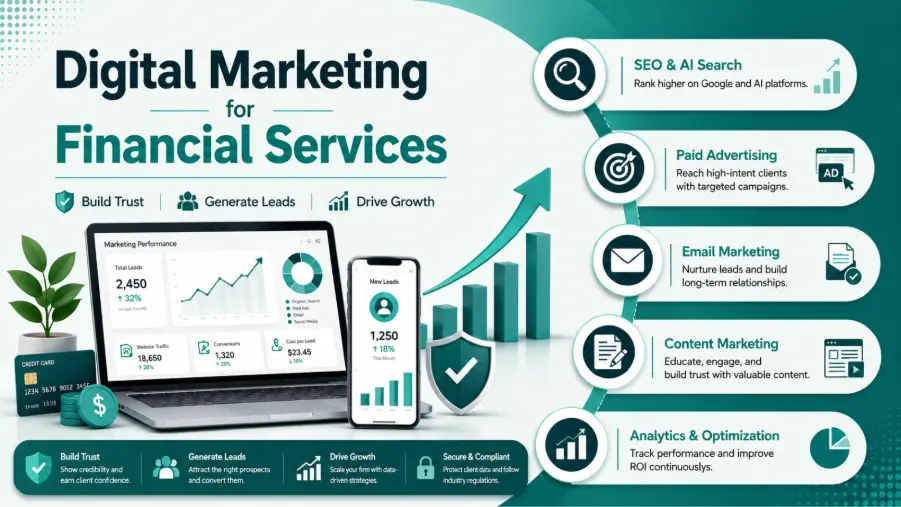
Search still drives most financial decisions. This includes both Google and AI tools. LinkedIn builds trust for advisors and B2B brands. Email nurtures long sales cycles. Paid search reaches buyers who are ready to act now.
Common Goals of Marketing for Financial Services
Most firms want the same things. They want better leads, lower costs per client, a stronger brand, and proof that marketing works.
Why Many Financial Firms Struggle to Generate Qualified Leads
Traffic without leads is a common complaint. A firm can rank well on Google and still lose. Visitors leave because they do not trust the brand enough to fill out a form.
A few problems show up repeatedly. Targeting is too broad, so leads come in weak. Ad costs climb because campaigns chase clicks, not real buyers. Weak trust signals push visitors away fast. Compliance reviews slow content down, so pages stay thin. Slow, cluttered sites confuse visitors. And without clean tracking, nobody can prove which channel drives real revenue.
The fix starts with brand trust and a website built to convert. More ad spend will not solve it alone.
Build a Strong Financial Brand Before Investing in Marketing
Ads spend without brand trust is like pouring water into a leaking bucket. Brand work must come first. Your firm needs a clear point of view. Say who you serve and why you serve them better than the next bank.
Consistency builds credibility. Use the same message, tone, and look across every page and post. Thought leadership and real research do more than another generic blog post.
Reviews, certifications, and case studies act as proof. Security badges and clear compliance notes tell visitors their data is safe.
If your firm lacks a clear look or voice, consider a branding agency for financial services. A financial services branding agency can define your tone and style. That work makes every future ad dollar go further.
Understand Your Target Audience Before Launching Any Campaign
Broad targeting wastes budget fast. Build a clear picture for each type of client you serve. A first-time homebuyer needs different content than someone planning retirement.
Map the buyer journey too. New visitors need simple education. Prospects further along need proof and comparisons. Ready buyers need one clear next step. Good targeting speaks to each group in its own way.
Build a High-Converting Website That Inspires Confidence
Your website will be the first actual contact that your potential customers will make with your business. It should be fast, easy to use on mobiles, and easy to navigate for any visitor.
There are certain things which become extremely important in the context of the health care industry. Show your license, your security badge, client testimonials, and how they can contact you at the very top of your landing page.
Your landing pages having one single goal such as scheduling a meeting or downloading a guide will outperform the homepage links having other goals. Always test your landing pages; little differences can bring huge results.
SEO Strategies That Increase Organic Visibility for Financial Services
Organic search still offers some of the best returns in marketing. But financial SEO needs extra care. Google holds money topics to a higher bar.
Start with keyword research built around real client questions, not just search volume. Group related content into clusters. A strong guide on retirement planning, backed by smaller linked articles, shows Google and readers real depth.
Technical work matters too. Site speed, mobile design, and page performance all affect rankings. Internal links help readers and search engines find their way around your site.
Local SEO helps firms with branches or state licenses. Earned links from trusted finance sites build authority. None of this works without tracking. Check your rankings, traffic, and leads every month.
Optimize Your Content for AI Search and Answer Engines
Google AI Overviews, ChatGPT, Gemini, Bing Copilot, Claude, and Perplexity now answer money questions directly. Many readers never click through to a website at all. Industry surveys show most financial marketing teams already plan for this shift.
Getting cited by these tools takes a different approach than old school SEO, often described as generative engine optimization. Write clear, direct answers to real questions by using plain and natural language.
Keep your brand facts consistent everywhere online. List your firm, services, and team the same way on your site and on other platforms. This helps AI tools trust and cite your content.
Write around topics and intent, not just single keywords. Answer real questions in a useful way. This is what strong AI search visibility rewards.
Develop a Content Marketing Strategy That Builds Authority
Content builds trust at scale. Blogs answer common client questions. Videos explain hard topics in plain terms. Webinars let prospects meet your team directly.
Case studies prove real results. Simple tools, like a mortgage calculator, keep visitors on your site and collect useful lead data. Original research sets your firm apart from brands that just repeat the news.
Reuse your best content. One webinar can become a blog post, a short video, and an email series. This saves time as budgets get tighter.
Use Paid Advertising to Generate Qualified Financial Leads
Paid ads bring fast results while your organic traffic grows. Google Ads reach people actively searching for help. Microsoft Ads often cost less and reach an older, higher income crowd. LinkedIn Ads work well for B2B finance and advisor recruiting.
Retargeting brings back visitors who left without converting. These visitors often convert best of all. Every campaign needs its own landing page. Every ad needs a compliance check before it goes live.
Strengthen Client Relationships Through Email Marketing and Automation
Money decisions rarely happen on the first visit. Email marketing keeps prospects engaged through a long research process. A CRM linked to your email tool tracks each contact and sends messages based on real actions.
Segment your list. A brand-new lead should not get the same email as a client of ten years. Keeping a client costs far less than winning a new one.
Use Social Media to Increase Brand Authority
LinkedIn remains the top platform for financial trust. When leaders share real insight, not just company news, it builds more trust than a company page ever could. This kind of platform-specific social media marketing works well for YouTube too, explaining tricky money topics on video. Reply to comments and questions in public. This shows real people stand behind your firm. Watch your online reputation closely and respond fast to any concerns.
Leverage AI to Improve Marketing Performance
AI assists with research, forecasting, personalized offers, and automation in finance marketing. Using predictive software helps to understand which leads will be successful. Thus, you enable your sales team to spend their time efficiently.
AI chatbots help to respond to regular inquiries instantly. As a result, your employees get more time to deal with complicated issues. In addition, AI helps to accelerate content creation. However, the human review is still required.

Maintain Compliance While Scaling Your Marketing
Growth cannot come at the cost of following the rules. Every ad and page must meet the standards set by your regulator. This could be FINRA, the SEC, a state banking board, or an insurance commissioner.
Clear disclosures protect your firm and your clients alike. Privacy rules around data and consent need clear, written policies. A second review before anything goes live catches costly mistakes early.
How to Measure Success
Measure the ROI of Your Marketing Campaigns
It is impossible to improve what is not measured. Monitor cost per customer, lifetime value per customer, cost per acquisition, and overall marketing return on investment.
The quality of the leads always wins over their quantity. The hundred low-quality leads take more of your team’s time than ten high-quality leads. Identify what channels bring results, not what channel was last clicked. It is easy to build a simple dashboard using GA4 or your CRM that will keep executives in the know all year round, not only quarterly.
Common Digital Marketing Mistakes Financial Firms Should Avoid
Skipping branding activity before spending on advertisements is a waste of time on traffic that won’t bring conversion.
Poor SEO, weak content, slow page speed, lack of tagging, prevents companies from being found in search engines. Unclear calls to actions confuse users about further actions. Poor analytics prevent proving the ROI to managers. Ignoring AI search is ignoring a channel that grows exponentially. Focusing on traffic rather than revenue ensures an empty sales pipeline no matter how much traffic you have.
How to Choose the Right Digital Marketing Agency for Financial Services
Not every firm need outside help right away. But most reach a point where their team cannot handle SEO, compliance, content, and ads all at once.
Look for a digital marketing agency for financial services when your team lacks SEO or compliance skills, growth has stalled, or leaders need better reports than you can currently produce.
Choose a finance marketing agency with real experience in your field. Ask for case studies and a clear compliance process. Ask how they will measure success and how fast results tend to show up.
Watch for red flags. Vague reports, promised rankings, no compliance process, and no finance experience are all warning signs. A strong digital agency for financial services sets honest expectations and explains its reasoning.
Future Trends Shaping Financial Marketing Beyond 2026
AI search will continue to evolve in the years to come because more users will choose to ask questions directly rather than click on links. First party data will gain in importance as the old tracking methods lose their power, which makes having a relationship with the customer even more important.
The predictive technology will continue evolving. Privacy-first marketing will become the rule rather than the exception. Voice search will also continue to evolve with AI assistants affecting financial decision-making more every year.
Where Should You Go from Here?
If your firm has strong products but no clear identity online, start with branding first. A branding agency for financial services can set a tone that makes every future campaign work harder.
If you need leads fast, for a launch or a new market, paid ads can fill the gap while your organic traffic builds in the background.
Growth in financial marketing rarely comes from one big move. It comes from getting the order right: brand, then website, then SEO, then paid ads, then scale, with compliance built in at every step. Talk to our team that understands both marketing and regulation before you spend your next marketing dollar.
Frequently Asked Questions
It means using SEO, content, ads, email, and social media to reach and convert clients for banks, fintechs, advisors, and insurers. It always follows strict rules around claims and disclosures.
Finances take time to make a decision on and carry great consequences. In addition, the financial industry is very regulated. Financial marketing must be persuasive and compliant with the regulations and facts.
Organic SEO and email marketing generate the best returns in the long run because they grow value over time, while paid search gives quick returns at higher prices.
They do different jobs. SEO builds lasting, low-cost visibility over time. PPC brings fast results for time sensitive campaigns. Most strong financial firms use both together.
Write clear, direct answers to real questions. Keep your brand facts consistent everywhere online. Build real topical depth so AI tools see your firm as a trustworthy source to cite.
Yes, once your team cannot keep up with SEO, compliance, and content all at once. A specialized agency understands both strong marketing and the rules your firm must follow.
Cost per client, lifetime value, lead quality, and ad return matter most. Traffic and rankings only matter once they turn into real leads and real revenue.