Introduction
Most architects think their portfolio speaks for itself. It doesn’t. You can have great project photos and still lose the job to a firm with plain work and a better website.
Here’s the part nobody tells you. Clients rarely pick an architect because of one great render. They pick you because you showed up first. You answered their question. You looked like you understood their problem before they even called.
That’s what content marketing for architects really does. It’s about being found at the right time. Someone types “how much does a house extension cost” into Google. If you answer that, you’re already ahead.
Most guides skip this part. They talk about “thought leadership” like it’s a magic word, then leave you with a vague plan and no idea what to write first. This guide fixes that, with a real plan, real numbers, and a straight answer on where content works and where it doesn’t.
The real problem with architect marketing
Here’s the mistake that costs firms the most. People think architecture is all about looks. So they think its marketing must be visual too. Instagram, Pinterest, a nice portfolio. Job done, right?
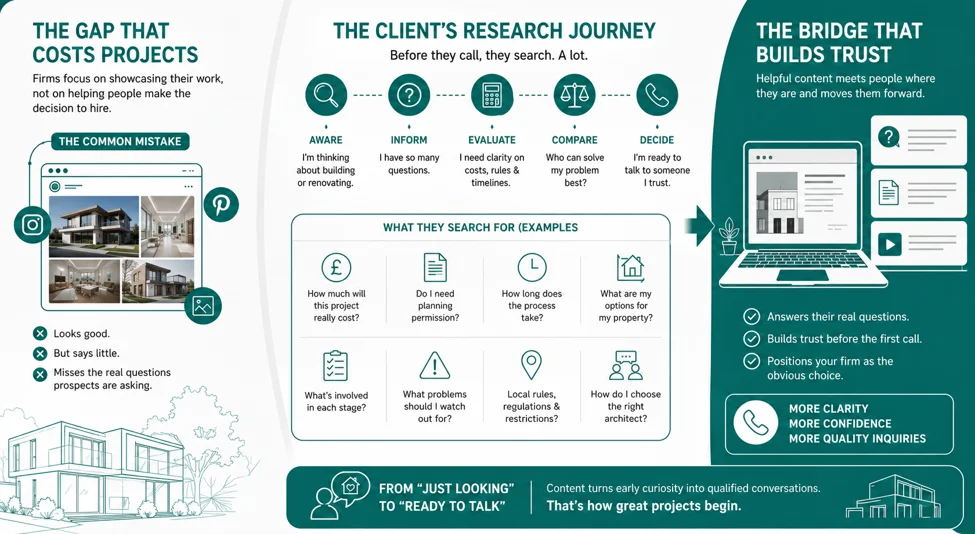
But hiring an architect is also a research job. Nobody wakes up and hires an architect on a whim. They spend weeks googling costs, planning rules, and “is it even worth it” questions, long before they pick up the phone. If your website doesn’t answer those questions, you’re invisible at the exact moment trust gets built.
This is why many well-designed architect websites get so little traffic. They show finished work beautifully. But they say nothing to the person who is still deciding whether to build at all. Content marketing fills that gap. It’s the bridge between “I’m thinking about this” and “I’m ready to call someone.”
What Content Marketing for Architects Means
Content marketing means you publish real, useful answers to real questions. Blog posts. Guides. Case studies. FAQs. Short videos. It’s not about going viral. It’s about being the answer when someone searches.
For architects, this usually means a few types of posts.
- Guides on planning rules and costs
- Case studies with real numbers
- Local posts for your area
- Green design and style pieces
- Simple FAQ pages, one worry at a time
None of these replaces your portfolio. It sits next to it, catching people early, before they’ve picked up a shortlist of firms to call.
Why this matters more for architects than most trades
Architecture has a long sales cycle. Clients often take weeks or months to decide, not days. During that time, they compare several firms. They read reviews. They quietly rule people out. Content keeps your practice visible and shows your skill while people are still deciding.
There’s also a trust gap in this trade. Many people mix up architects with interior designers or builders. Some don’t even know they need an architect until they’re deep into a project. Good content fixes this early. It shows people what an architect does. That way, they don’t hire the wrong person.
The numbers back this up. Search demand is genuinely large. There are roughly 449,000 monthly searches for architects worldwide. The UK market is crowded too. Nearly 39,000 architects are registered in the UK. Ranking well isn’t a nice extra. It’s how you get a steady flow of new leads, instead of relying only on referrals.
Architecture marketing strategy: where to start
Don’t start with a content calendar. Start with a question. Who do you want to reach, and what do they type into Google before they call anyone?
A home architect writes differently to a firm chasing office jobs. Pick three or four project types you want more of. Build content around the questions those clients ask, at every stage.
Early on, they research cost and whether it’s possible. In the middle, they compare firms and study past work. Near the end, they want proof you deliver on time. Your plan needs pieces for all three stages, not just photos aimed at the middle one.
A simple content plan for architects
A simple plan you can keep up with beats an ambitious one you abandon in six weeks. Most small firms do well with two to four solid articles a month. Add regular case studies from finished projects.
A workable monthly rhythm looks like this.
- One deep guide (cost or planning rules)
- One project story, with a real budget and result
- One local or seasonal post
- One FAQ update, based on a real client question
Keep a running list of every question a client has ever asked you. That list is your whole content plan for the next year. You don’t need to guess. You’ve already been asked.
Architecture content ideas that get read
Generic “design trends of 2026” posts rarely bring in new leads. What works is content tied to a real decision someone is trying to make. A few ideas that keep performing well for architecture firms.
- Cost guides by project and area
- Planning rule guides for your council
- Before and after posts, with real budgets
- Green design posts tied to cost
- Design fixes for small or tricky plots
- Architect versus builder versus designer
The theme here is being clear and real. Vague posts rank poorly and convince nobody. A real number, a real project, or a named town does more work than a general line about “great design.”
SEO content for architects: getting found, not just read
Good content means nothing if nobody finds it. SEO for architects has a few basic rules.
Target the words your real clients search. Not just industry jargon. “Residential architect near me” matters more than “parametric design philosophy.” Write clear titles that match how people ask questions. Use proper headings on long guides. That way, both readers, Google, and AI search tools can scan them fast.
Your portfolio pages need SEO too. Photos alone won’t rank. Add real text, location details, and project context to every page. Skip the bare gallery with no words.
Local SEO matters just as much as blog content. Often more.
Local SEO for architects UK: the part people skip
If most of your work comes from one area, local SEO matters a lot. It might matter more than blog traffic. Someone searching “architect in Bristol” is close to hiring. Someone reading a design article is not.
A few things help here. Keep your Google Business Profile full and up to date, with real photos. Collect honest client reviews and reply to them. Mention your service areas in your website copy, kept natural, and get listed in local directories too.
This takes longer to set up than a blog post. But it keeps paying off. Once your local presence is solid, it brings in leads with very little extra effort.
Architecture lead generation: turning readers into enquiries
Traffic with no enquiries is a vanity number. Every piece of content needs a next step. Even a small one.
That doesn’t mean a pushy “call now” button on every page. It means a clear, low pressure step. A checklist to download. A simple form. A “book a call” link at the end of a guide, not shoved into the first line.
Case studies do heavy lifting here. They show real results and real budgets, which beats a mission statement, since they answer the question every prospect has. Can this firm deliver what I need?
Blogging for architects: how often, and how long
You don’t need to post every day. Being consistent beats being frequent. Two solid posts a month, published reliably, will beat ten rushed ones that stop after two months.
Length depends on the topic. A cost guide or planning post usually needs 1,200 to 2,000 words to answer the question properly. A quick project update can be much shorter. Match the length to the question, not to a random word count target.
The biggest mistake firms make is treating blogging as a one off task, not a habit. One burst of posts, then silence for a year, does very little for your rank or your name.
Website content for architects beyond the blog
Your blog is only one part of the picture. The rest of your website needs to pull its weight too.
Your homepage should say clearly who you serve and what projects you take on. Your services pages need real detail, not just buzzwords.
Your about page should build trust, not just list your qualifications. Your project pages need context too: budget range, timeline, challenges, and outcome, next to the photos.
Think of your whole site as one long piece of content marketing. Not just the blog tucked away in the footer menu.
Content marketing cost in UK: what to expect
This is where architects often get burned. Either they pay too much for too little, or go so cheap the content does nothing.
Rough UK numbers for 2026 look like this. A single blog article typically costs between one hundred and four hundred pounds. It depends on length and how technical the topic is. A steady run of two to four articles a month usually costs four hundred to twelve hundred pounds a month for content alone.
Want more, with a plan and SEO built in? Expect a bigger monthly fee. Small business agencies in the UK typically charge one to three thousand pounds a month for content, SEO, and reporting together. Most architecture firms spend around four to six percent of yearly revenue on marketing overall. Content is one slice of that, not the whole budget.
Be careful with anything priced far below these numbers. Below roughly five hundred pounds a month, the math’s rarely works. That’s barely one day of a good freelancer’s time. It won’t cover real research, writing, and optimizing.
Content marketing agency UK vs doing it yourself
Should you hire an agency, or write it yourself? It comes down to your time, and how confident you are as a writer.
Doing it yourself works if you enjoy writing and have a couple of spare hours a week. Nobody knows your clients’ worries better than you. The risk is consistency. Firms get busy, and blogging is usually the first thing dropped.
A marketing agency or freelancer solves that problem, and usually writes tighter, more search friendly copy too. The tradeoff is cost, and the need to brief them well. A mixed approach works for many firms: you give the raw material, project details, real questions, and a writer shapes it into polished content.
Digital marketing for architects: where content fits in
Content marketing doesn’t replace the rest of your marketing. It works alongside it. Paid ads bring fast leads, but stop the moment you stop paying. Content builds slower, and keeps working long after you publish, since the page stays live.
Firms getting the best return, often five pounds back for every pound spent, tend to run several channels together, not just one. Content feeds your SEO. It gives you something to share on social media. It gives your ads somewhere useful to send clicks.
If you can only pick one channel this year, pick content and SEO together. The value keeps building, instead of switching off the day your budget runs out.
If you’re not a mid-size firm with a marketing budget
Most guides assume you’re a mid sized firm with a budget and a person to manage it. That leaves a few groups out.
Sole practitioners and small firms often can’t pay for a big monthly plan. For you, the answer is simple. Do less, but do it steadily. Pick one type of post. Case studies are the easiest choice, since you have the material already. Publish steadily. Don’t try to do everything at once.
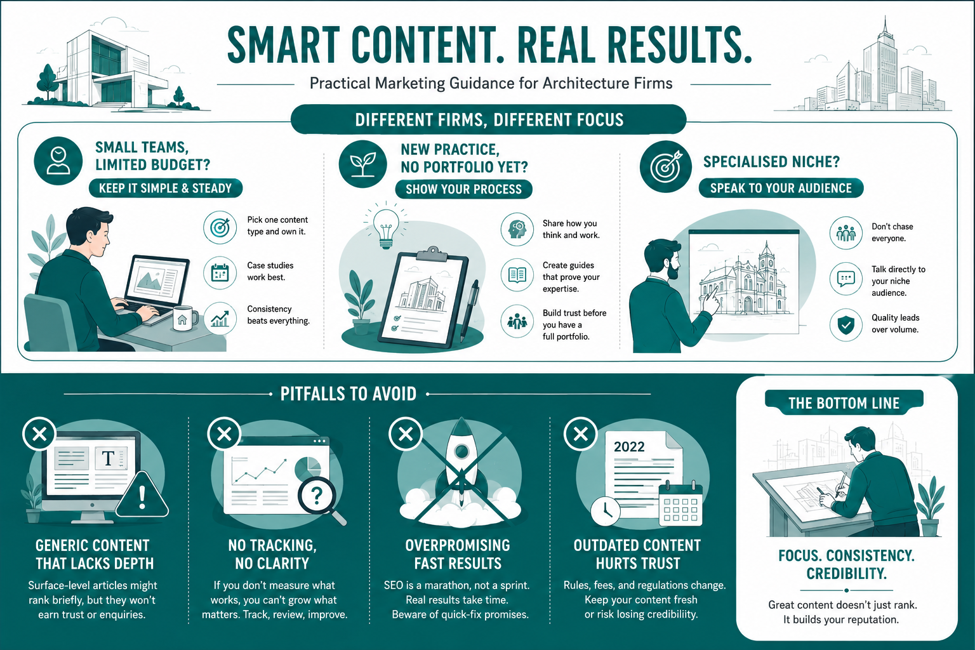
New practices with no finished projects face a different problem. You can’t show case studies you don’t have. Lean on process posts instead. Show how you think and how you work. Guides that prove your skill, even with no full portfolio yet.
Firms in a narrow niche, like old buildings or eco homes, often get advice that doesn’t fit. Broad posts for “homeowners” won’t reach a planning officer. Speak straight to your smaller group, even if fewer people search for it.
Where architects lose money on this
A few honest warnings. These come from real complaints firms run into.
Content that reads like it came from a generic agency with no real trade knowledge. It might rank for a while, then do nothing for trust once a reader senses it’s shallow. Vague, unmeasured campaigns are another common problem. If nobody tracks which pages bring in enquiries, you can spend months on content with no idea if it’s working.
Overpromising causes real pain too. Ranking well takes time. Often three to six months. Sometimes longer in busy cities. If someone promises fast page one results, be careful. That’s either false, or it uses tricks that can hurt you later.
Watch for content that never gets updated too. A planning guide from two years ago might already be wrong, since rules and fees change often. Stale advice damages trust faster than having no content at all.
Conclusion:
Marketing costs and pricing shift often. Treat these numbers as a guide only. Check the current rates with any firm before you sign up.
If you’d rather hand this whole job to people who do it daily, A8OM works with UK firms on content, SEO, and website plans. Their approach is built around what your clients search for, not a fixed template. Worth a chat if you want a plan built around your practice, not a copy paste playbook.
Frequently Asked Questions
Most firms see real traffic and enquiries after three to six months of steady posting. Architecture has a long decision period, so patience matters more here than in faster trades.
Yes. A portfolio shows finished work to people who already know they want an architect. A blog reaches people still deciding if they need one. That’s a much bigger group.
Content is what you make. SEO is how people find it. You need both. Great content with no SEO gets buried. Great SEO with weak content ranks briefly, then falls back fast.
It helps, mostly Instagram and Pinterest, for visual work. But social media works best as a place to share posts you’ve already made. It’s not a swap for your own site and blog.
There’s no magic number. But most firms need twenty to thirty solid pages before search traffic starts to add up. Being steady matters more than hitting a set count fast.