
Introduction
Ask three agencies what digital marketing costs, and you’ll get three completely different answers. One quotes £500 a month. Another wants £3,000. The third won’t give you a number until you’ve sat through a discovery call where they ask about your “goals and vision.” Meanwhile, you’re just trying to figure out if you’re about to get ripped off.
The industry runs on this confusion. There are no standard rates, no fixed prices, no regulator saying what’s fair. Which means the business that walks in knowing nothing pays more and gets less than the one that comes prepared. This article is for the second type.
What Digital Marketing Actually Costs in the UK Right Now
SEO
The cheapest SEO packages in the UK go for £150 to £400 a month. They exist, they’re everywhere, and they mostly produce PDF reports and keyword rankings for terms nobody’s searching. Real SEO work costs more.
For a small business targeting a local or regional area, a proper monthly retainer runs £750 to £1,500. National campaigns where you’re competing for high-volume terms, with content production and link building included, will run £2,000 to £3,000 a month. Freelance SEO consultants charge anywhere from £50 to £250 an hour, depending on experience.
One thing I’d genuinely recommend before signing any SEO retainer: pay for a standalone technical SEO audit first. Costs £500 to £1,500 as a one-off, and it tells you whether the site has real issues that need fixing or whether an agency is manufacturing problems to justify a contract. Worth every penny.
SEO is slow. Not six weeks slow. Six to twelve months before you see consistent organic traffic. Anyone promising page one results in a month is either targeting keywords with no search volume or lying to your face.
PPC
The thing that catches most business owners out with PPC is that the number an agency quotes you isn’t the full cost. That’s the management fee. On top of that, you’re paying Google or Meta directly for the actual ad spend. Two separate invoices. Two separate line items.
Agency management fees for a basic Google Ads setup start around £400 to £600 a month. Running campaigns across both Google and Meta with proper oversight costs £800 to £1,500 in fees. Then your actual ad budget on top of that. Most UK SMEs start with £500 to £1,000 a month in ad spend. Sectors like finance, legal, or anything property-related will need more because the cost-per-click is higher.
PPC works fast when it’s set up properly. You can have leads coming in within a couple of weeks. But the second you stop funding it, everything stops. No residual traffic, no compounding effect. That’s the real tradeoff versus SEO.
Social Media
Organic social management, meaning someone creating and posting content on your behalf without paid ads behind it, runs £250 to £1,500 a month. The lower end is usually one platform, limited content, and basic engagement. At the higher end, you’re getting a proper content strategy across two or three channels with someone who understands what they’re doing.
Once you add paid social campaigns to the mix, the monthly number climbs. Factor in content creation, ad management fees, and the actual ad spend, and most UK businesses are looking at £800 to £3,000 a month all-in.
The truth about social media is that ROI is hard to attribute, particularly in B2B. Impressions and follower growth are easy numbers for agencies to show you. Whether any of it generated a sale is a different question. If you’re paying for social and you’ve never been able to point at a single customer that came from it, that’s worth examining.
Email Marketing
Email gets underestimated constantly. It’s one of the cheapest channels to run and for businesses with an existing customer base or a warm lead list, it often outperforms everything else.
Getting the email marketing setup done properly, including automated sequences, segmentation, and strategy, costs £500 to £1,500 as a one-off project. Monthly management after that, where an agency handles copy and sends, runs £300 to £800. But once the foundations are in place, this is also one of the channels you can realistically run yourself. Mailchimp starts at around £30 a month. Klaviyo scales with your list. Neither requires technical expertise to operate day-to-day.
Content Marketing
Blogs, landing pages, case studies, white papers. For most businesses, content is the engine underneath SEO. Without it, your rankings don’t improve because there’s nothing new for Google to index and nothing for other sites to link to.
A single blog post from a decent UK agency runs £300 to £600. Longer, well-researched pieces go up to £1,200. Monthly content retainers that include strategy, writing, and publishing start at £750 and scale to £5,000 for high-volume output. The payoff is slow, but unlike paid channels, a piece of content that ranks keeps generating traffic long after you’ve paid for it.
What SMEs Actually Spend Versus What Works
Most UK SMEs who are genuinely getting value from their digital marketing spend somewhere between £1,000 and £3,500 a month. That’s not a guess. That’s what agencies consistently report as the range where SMEs are doing more than just maintaining presence but aren’t yet at the point of needing a full in-house team.
Below £750 a month, you’re really just keeping the lights on. A bit of activity, a monthly report, nothing that’s likely to move revenue.
The £1,000 to £1,500 bracket buys you one or two channels handled properly. Not both at full capacity. You pick: SEO and content, or paid search, or social with some ad spend behind it.
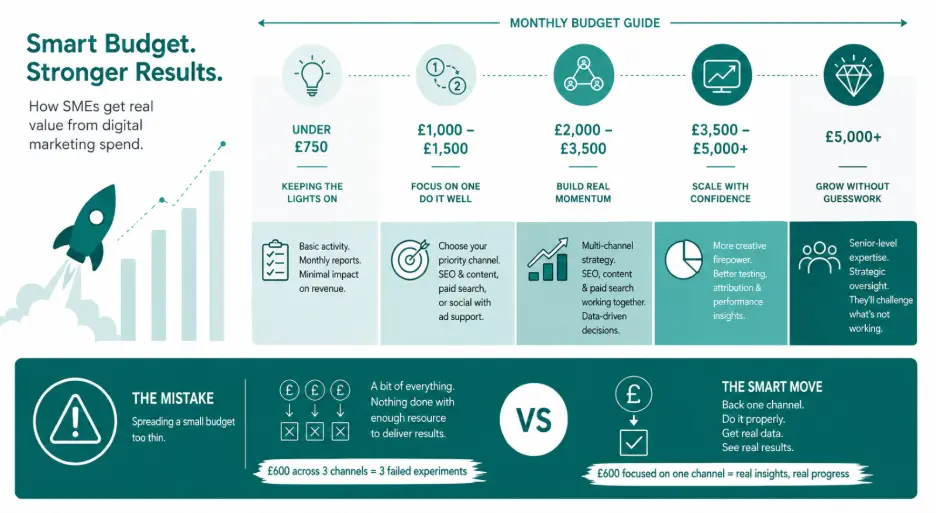
At £2,000 to £3,500, you can run a real multi-channel growth setup. SEO, content, and paid search working together with someone actually looking at the data across all three.
Above £5,000 you’re into territory where you’re funding proper creative work, testing, attribution, and a senior enough team that they’ll push back when something isn’t working.
The mistake most SMEs make
They split a small budget across too many channels. A bit of everything, nothing done with enough resource to actually produce results. £600 a month split three ways is three failed experiments. £600 a month on one channel, run properly, at least gives you data.
What You’re Actually Paying For When You Hire an Agency
The pricing models
Monthly retainers are the default. You pay a fixed fee for a defined scope each month. In theory that scope should tell you exactly what you’re getting: how many hours, which deliverables, how often you get reporting. In practice, plenty of agencies quote a monthly fee with a vague channel list and nothing more specific than that. If a proposal doesn’t have deliverables broken down, it’s not a scope, it’s a holding statement.
Project fees suit one-off work: site audits, campaign launches, content builds. These typically run £1,500 to £10,000 depending on what’s involved.
Performance deals, where you only pay when results come in, sound like a good idea. Most good agencies won’t touch them because the incentive structure pushes toward short-term results and away from the foundational work that actually builds long-term value.
What you’re paying for inside that fee
When an agency quotes you £2,000 a month, the majority of that isn’t someone sitting at a keyboard doing work for you. It’s the account manager who runs your relationship, the tools the agency licenses, the internal time spent reviewing and strategy planning, and the reporting. You’re paying for a process as much as execution.
The seniority of whoever works on your account makes an enormous difference. Someone who’s run similar campaigns ten times before makes different decisions than someone following a checklist. Both agencies will describe themselves the same way on a proposal. Ask directly who will be working on your account, how long they’ve been at the agency, and whether you can speak to them before committing.
London agencies charge more. Usually 20 to 25% more than comparable agencies outside the capital. Now that remote work is normal, there’s very little reason to pay the London premium unless the specific team has a track record that justifies it.
The package label problem
Most agencies will show you tiers: Starter, Growth, Premium, something like that. These names mean nothing consistent across the industry. One agency’s Growth package is another agency’s basic entry offer. Never compare packages by name. Ask for a written breakdown of exactly what tasks get done each month and compare those.
What Actually Goes Wrong
The things that cost SMEs money
No written scope is the most common one. Without specific deliverables in the contract, you have no basis for a conversation when results don’t come. You’re just paying for effort with no standard to hold anyone to.
Vanity metrics are the follow-on problem. An agency that leads every monthly call with impressions, reach, and follower counts while your actual enquiry volume stays flat isn’t delivering results, they’re managing your perception of results. Push for cost per lead, conversion data, or at minimum organic traffic that’s tracked against real keyword targets.
Twelve-month lock-ins with no performance clause. Six months is a reasonable minimum commitment for a campaign to show what it can do. Twelve months with no exit if targets aren’t hit is a different animal entirely. Some agencies rely on these contracts to carry clients who aren’t seeing results past the point where they’d otherwise leave.
Slow or absent reporting. If you’re chasing your agency for a report, and when it arrives it’s a static PDF with no context or commentary, they’re billing you but not managing you. There’s a difference.
The underspend trap
Cash gets tight and digital marketing is usually the first line to get cut. What follows is a predictable cycle: an SEO retainer at £350 that produces reports but nothing moves, a paid campaign paused at six weeks before it’s gathered enough data to optimise, a content strategy that never got past the planning document because the budget ran out.
Spending half what something actually requires isn’t a compromise. It’s usually a total waste. If you genuinely can only spend £600 a month right now, put all of it into one channel and see what it does. Splitting it across four channels and hoping something sticks is the most expensive approach available to you.
Where it’s genuinely harder: niche B2B
A lot of guides about digital marketing costs assume you’re selling something with a reasonably broad consumer market. If you’re selling a specialist industrial product, a professional service to a small sector, or B2B software to a specific type of company, the standard playbook doesn’t translate directly.
Search volumes are lower. Buying cycles are measured in months, not days. The people making purchase decisions aren’t browsing their phone and clicking ads. LinkedIn and content that addresses very specific problems often outperforms paid search by a wide margin for these businesses. The digital marketing services cost question here is really about what a new client is worth to you. A business closing £50,000 contracts can justify spending £3,000 a month to generate two qualified leads. A business on £500 monthly subscriptions probably can’t.
How to Actually Cut Digital Marketing Costs Without Cutting Results
Cut these first
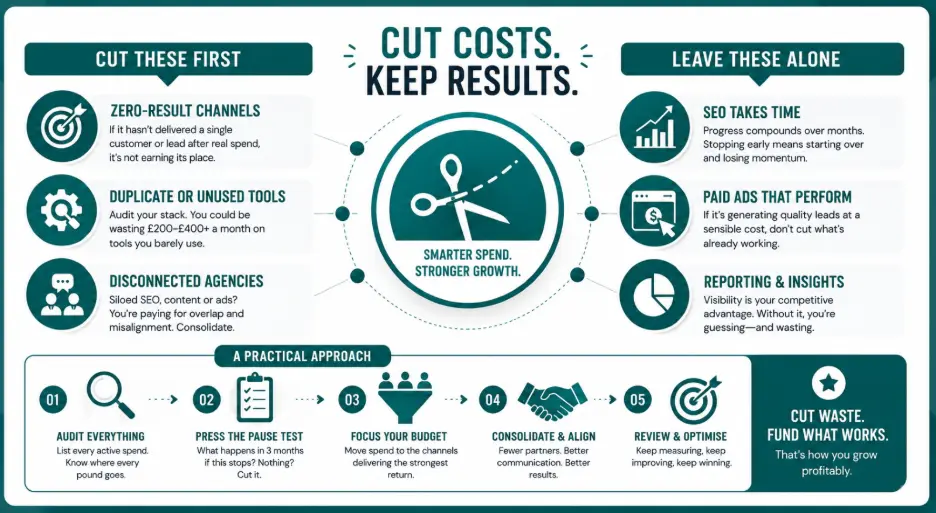
Any channel where you’ve spent real money over an extended period and genuinely cannot point to a single customer it generated. Not “we think it builds brand awareness.” An actual lead or customer.
Duplicate or underused tools. Most small businesses are paying monthly for a CRM they set up once, an analytics tool they never log into, a social scheduling platform they use twice a month. A proper tool audit usually frees up £200 to £400 a month.
Two agencies that aren’t talking to each other. If you’re paying one agency for SEO and another for content and they’ve never had a conversation, you’re paying for coordination overhead that doesn’t exist. One agency handling both is almost always cheaper and the work is better integrated.
Leave these alone
Don’t stop an SEO campaign mid-way through. Rankings that have started to move take months to build. Stop the campaign at six months and most of that progress decays over the following few months. Restarting from scratch costs more than continuing.
Don’t cut paid search while it’s generating leads at a cost that makes commercial sense. If the cost per lead is reasonable and it’s producing sales, cutting it to save the agency fee is counterproductive arithmetic.
Don’t remove reporting from your agency’s scope. If you can’t see what’s working, you can’t make good decisions about what to keep funding and what to cut. Reporting isn’t an overhead. It’s the mechanism by which you stop wasting money on everything else.
A practical approach to reducing spend
Go through every active spend line one by one. For each one, ask honestly: what would happen in the next three months if this stopped? If the answer is probably nothing, cut it. If the answer involves lost traffic, lost leads, or lost revenue, it stays.
Then tell your agency you want to consolidate. Drop the weaker channels and put that budget into whatever is showing the strongest return. A good agency will be fine with this. An agency that pushes back when you ask to cut underperforming channels is protecting their retainer value, not your results.
Digital Marketing Course Costs
Worth covering separately because a meaningful number of people searching for digital marketing cost are asking about training rather than services.
Free options that are actually useful
Google’s Digital Garage is free and the content is genuinely decent for someone starting from scratch. HubSpot Academy is also free and covers email, content strategy, and inbound marketing in real depth. These won’t turn someone into a specialist but they’re worth several hours of anyone’s time if they’re managing their own marketing activity.
Short courses on Udemy and Coursera run £15 to £200 per topic. The quality varies but the good ones on Google Ads, SEO foundations, and Meta Ads are genuinely useful for business owners who want to understand what they’re paying agencies to do.
The CIM qualification route
The Chartered Institute of Marketing runs the most recognised professional qualifications in UK marketing. The Level 3 Foundation Certificate costs around £800 to £1,200 through a study centre, before CIM membership fees and exam costs. The Level 4 Certificate is higher again. The Level 6 Diploma, which sits at degree level, costs £997 to £1,597 depending on the provider, with CIM assessment fees adding around £660 on top.
For business owners looking to upskill a member of staff, short platform-specific courses deliver better practical value faster. CIM qualifications are worth the investment for someone who wants to build a long-term marketing career, not for someone who needs to understand Google Ads by next month.
Honestly, the fastest way to actually understand paid search is to spend £200 running your own test campaign and see what happens. The fastest way to understand SEO is to work consistently on one website for six months. A course gives you the theory. Doing the work gives you judgment.
How A8OM Helps
If you’re looking at a stack of agency proposals and none of them quite make sense, or you’re not sure whether what you’re spending is working, book a free strategy call with A8OM.
A8OM works with UK businesses on exactly that problem: getting digital marketing spend pointed at things that actually matter.
FAQs
Realistically, £750 to £3,500 a month for an agency handling two or three channels for an SME. Below £750 you’re in maintenance territory. Above £5,000 you’re funding a proper multi-channel growth operation. Ads spend is always separate from the management fee.
Most UK small businesses on a monthly retainer are paying between £1,000 and £2,000. That gets one or two channels to run properly. Any ad spend sits outside that number.
Up to a point, no. A junior marketing hire costs £25,000 to £32,000 in salary before you add tools, training, or management time. An agency at £1,500 a month is £18,000 a year, and you get a full team. Once you’re at the stage where you need senior strategic input every day and you’re spending £4,000-plus a month on external agencies, an in-house hire starts to make more financial sense.
Usually because they’re not actually quoting the same thing. Scope, seniority of who does the work, and location account for most of the gap. Two proposals labelled “SEO” can represent completely different amounts of work. Always get the deliverables in writing before comparing numbers.
Some of it, yes. Email to your own list, organic social posting, and basic blog content. Paid search and technical SEO are harder to get right without making expensive mistakes early on. A lot of SMEs run a hybrid: handle the lower-skill channels in-house and pay for the specialist work. That’s usually the most cost-efficient setup.
SEO: typically, six months before you see clear movement, twelve before it’s reliable. PPC: weeks, if the campaign is properly built and funded. Content: slow to gain traction but keeps compounding. Anyone telling you there’s a faster route either doesn’t understand how this works or has something to sell you.