Introduction
Your customers are looking for you online. If they can’t find your website, they will find your competitor’s instead. It is as simple as that.
We’ve spent 15 years working with small UK firms. The situation is usually the same: tight budgets, big brands hogging the front page, and no real strategy. Most owners try a bit of Facebook one week and some SEO the next. Then they wonder why the phone isn’t ringing.
You don’t need a massive bankroll. You need a plan that actually converts. This guide shows you how to build a marketing strategy that brings real buyers to your door, not just “likes” or “impressions.”
What Is Online Marketing for Small Businesses?
At its heart, online marketing is just getting your message to customers via the internet. It replaces old-school methods like flyers or local paper ads.
Traditional marketing usually interrupts people. You are watching a show and an ad pops up. You are reading a magazine and see a full-page spread. That is “push” marketing. You are shoving a message at people whether they want it or not.
Online marketing works in reverse. Someone is already looking for what you offer. They type “accountants in Leeds” into Google. If you have done your job well, you appear at the top. That is “pull” marketing. They came to you because they had a need.
For UK small businesses, that happens through:
- SEO gets you showing up when people search Google.
- PPC puts your ads at the top of those search results.
- Social media builds relationships on platforms your customers use.
- Email keeps you in touch with people who know you.
- Content proves you know your stuff through blogs and videos.
Why Online Marketing Actually Works for Small Businesses
The benefits of online marketing for small businesses show up where it matters – your bank account.
Geography stops limiting you. A shop in Cornwall traditionally serves only Cornwall. Same shop online ships to Edinburgh, London, Manchester, and anywhere. That craft gin distillery in Cornwall? Went from serving three villages to shipping nationwide. Same product. Different reach.
The cost difference is massive. TV ads cost tens of thousands. Magazine spreads aren’t much better. Google Ads? Start with five quid a day. Scale up when you see results instead of gambling everything on one big shot.
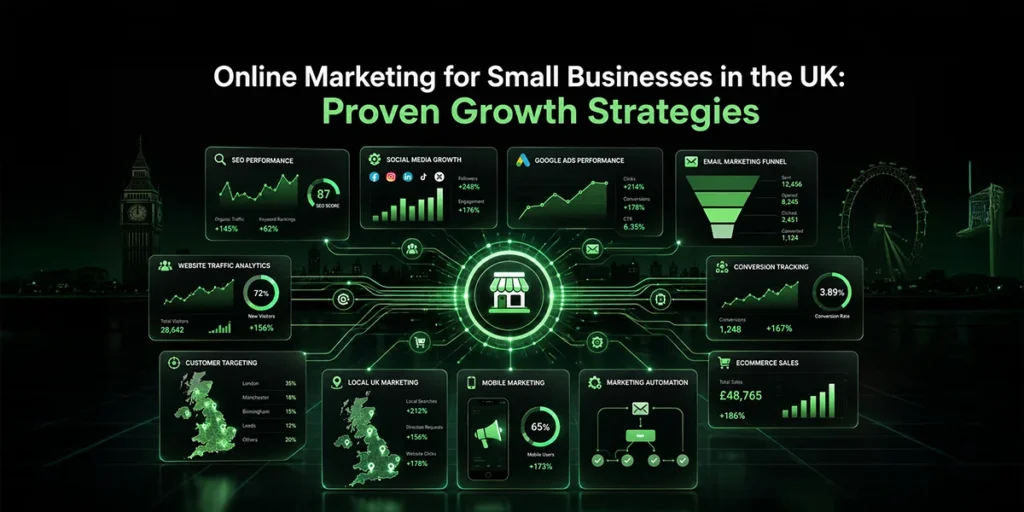
This is where online marketing for small businesses in the UK really wins – targeting. Show ads only to people in specific postcodes. Only to people with certain job titles. Only to people who visited your pricing page yesterday but didn’t buy it. You’re talking to people who actually care, not shouting into space.
Tracking changes everything, too. Traditional marketing has the old problem: half your budget gets wasted, but you don’t know which half. Digital shows every click, every conversion, every pound that worked. Your marketing ROI for a small business improves when you kill what doesn’t work and double down on what does.
Which Channels Actually Work for Small Businesses
Search Engine Optimisation (SEO)
SEO builds slowly. Marathon, not sprint. You’re building a website that Google learns to trust over months.
Local SEO matters most for small businesses. An accountant in Leeds appearing in Google’s Map Pack for “accountants near me” is worth thousands of dollars per year. Just from that placement. Takes three to six months before you see real movement, though.
Google Ads and PPC
PPC delivers speed. SEO’s the marathon; this is your sprint.
PPC offers speed. If SEO is a marathon, PPC is the sprint. You only pay when someone clicks. This is perfect for high-intent searches. If someone types “emergency plumber Bristol,” they need help right now. You want to be the first number they see.
Social Media Marketing
It’s about more than just getting “likes” on Social Media. If you sell to other firms, use LinkedIn to find the right people. If you sell to the public, get on TikTok or Instagram. The secret? Just stay consistent. Don’t spend all your time selling, either. People can spot a pushy advert from a mile away, and they’ll just scroll past you.
Content Marketing
Creating helpful content builds authority. A landscaping company writing about preparing UK gardens for winter isn’t just selling services; it’s also sharing knowledge. They’re showing they know their stuff.
Matters more now that AI answers queries directly in search results. Your content marketing timeline for 2026 should focus on unique insights that AI can’t scrape from other sites.
Email Marketing
Email is one of the few channels you control. Social media algorithms change weekly. Your email list stays with you.
Best tool for keeping customers coming back and buying again. Most businesses ignore this completely. Mad, really, considering it typically delivers the highest ROI of any channel.
Building Your Online Marketing Plan
Here’s the mistake we see constantly. People pick tactics first. “We need TikTok” without knowing why. A proper online marketing plan for a small business follows a logical set of steps.
Step 1: Set Clear Goals
Are you just looking for “fame” or do you actually need 20 new phone calls this month? You have to be crystal clear here. Pick target you can track and reach by a set date. If your goal is confusing, you are just throwing your budget at a wall to see what works.
Step 2: Know Your Audience
Figure out who you’re talking to. “Everyone” isn’t an answer.
Selling premium eco-friendly paint? Your audience isn’t just homeowners. It’s environmentally conscious for homeowners aged 30-55, with a household income of over £60k. Understand what keeps them up at night. Maybe toxic fumes around their kids.
Step 3: Choose Your Channels
Pick two or three channels that make sense for your niche. Master those before spreading thin. Solicitor? Probably don’t need Pinterest. Master what matters first.
Step 4: Set Sustainable Budget
Classic mistake: blowing everything in month one, leaving nothing for optimisation.
Step 5: Track Everything
Get Google Analytics 4 running day one. Can’t improve what you don’t measure.
What Marketing Actually Costs
“How much should I spend?” is the most common question we get. While there is no magic number, there are benchmarks. Established firms spend 5% to 10% of their revenue on marketing. Startups often spend 15% to 20%.
Here’s what you’ll pay:
- SEO: Expect to pay £500 to £2,000 per month. Anything less often involves “dodgy” tactics that could get you banned.
- Social Ads: A budget of £600 to £1,500 monthly helps the algorithm learn who your buyers are.
- Website: A good site starts at £2,500. Complex shops can cost over £10,000.
- Full-time Manager: A salary of £35,000 to £50,000 plus benefits.
This is why many UK firms choose an agency. For the price of one staff member, you get a whole team of experts.
Measuring Your Marketing ROI
Understanding your marketing ROI as a small business separates growing companies from stalling ones. ROI shows the profit per pound spent.
The formula is simple: gain from investment minus cost of investment, divided by cost of investment, multiplied by 100. Spend a grand on Google Ads, generating five grand profit? That’s 400% ROI.
Tracking needs proper tools, though:
- Google Analytics 4 tracks website traffic and what people do
- CRM like HubSpot or Pipedrive follows leads from first contact through sale
- Call tracking, like Rule or CallRail, is essential for service businesses where conversions happen over the phone
SEO Timeline: What to Expect
We tell clients constantly: SEO is a capital investment, not a monthly bill. Ads stop working when you stop paying. SEO builds value that sticks around. But the SEO results timeline small business owners should expect takes patience.
Months 1-3: Foundation Work
Technical fixes, site speed improvements, and keyword research. Won’t see the lead explosion yet, but Technical Health scores are improving, and your site is starting to get indexed for relevant searches.
Months 3-6: Content Starts Ranking
Long-tail keyword traffic increases. Your Google Business Profile appears more often in local searches. You’ll start seeing real visitors from organic searches.
Months 6-12: Compound Interest Kicks In
Steady organic traffic flows. Cost per lead drops noticeably compared to paid channels. Not seeing movement by month nine? Something’s broken in strategy or execution.
Freelancer or Agency?
When scaling up, you’ll eventually need to hire a marketing freelancer rather than an agency. Neither’s automatically better. They fit different needs.
Freelancers work best when:
- You need specific tasks done – four blog posts monthly, a small PPC account
- Budget’s tight, and you can manage the relationship yourself
- You’re comfortable with limited availability
Agencies make sense when:
- You want comprehensive online marketing packages for a small business
- You need multiple skills – strategy, design, SEO, paid ads
- You’re ready to invest £1,500+ monthly
Our experience suggests the debate is decided around the £1 million turnover mark. Below that, freelancers or small agencies usually make the most sense.
Marketing Mistakes Killing Growth
Even with the best online marketing tools for small businesses, mistakes are easy to make. Here are the marketing pitfalls small business owners hit most:
No Clear Strategy
Running ads because you feel you should, without a landing page or follow-up process. Map the customer journey first before spending anything.
Ignoring SEO for Quick Fixes
Relying only on Facebook ads. Ad costs jump, and suddenly your business struggles. Put 20% of ad profits into long-term SEO instead.
Not Measuring Performance
“We think it’s working” isn’t a strategy. Install tracking pixels and actually check monthly reports.
Inconsistent Campaigns
Starting a blog, writing three posts, then nothing for six months. Build a content calendar and stick to something realistic.
GDPR Compliance Checklist
ICO doesn’t mess about data protection. Use this GDPR marketing checklist to stay legal:
- Explicit Consent: Use an unticked box for sign-ups.
- Easy Unsubscribe: Every email must have a “quit” link.
- Cookie Banner: Let people opt out of tracking.
- Privacy Policy: Clearly explain what you do with data.
- Minimal Data: Only ask for what you actually need.
What’s Coming in 2026
AI is reshaping everything in online marketing for small businesses right now.
Marketing is shifting from mass to hyper-personal. Small businesses use AI to trigger emails based on specific user actions. Google now answers more queries directly on the search page using AI, too. Your content marketing timeline 2026 needs to focus on unique insights that AI can’t just scrape from other sites.
Tools costing thousands before now go for 20 quid a month, letting small teams handle complex automation they couldn’t touch before.
How A8OM Helps Small Businesses Grow in UK
At A8OM, we cut through the noise for UK small businesses. You don’t need to fluff. You need the results. Our online marketing solutions for small businesses are data-driven and focused on actual ROI.
We offer online marketing packages for small businesses scaling with you. Whether data-driven SEO dominates your local market or high-performance paid ads boost quarterly sales, we focus on metrics that affect your bank balance. Our content marketing campaigns work for 2026’s reality, optimised for both human readers and AI search engines.
Final Thoughts
Mastering online marketing for small businesses isn’t about having the biggest budget. It’s about having the smartest strategy. The UK’s competitive landscape rewards businesses that treat marketing as a structured, long-term investment rather than a series of random costs.
Focus on high-intent search combined with nurturing the existing audience through content and email. That creates a proper growth engine. The most successful online marketing plan for a small business gets executed consistently and measured ruthlessly.
The digital world moves fast in 2026. Don’t let your business fall behind with wait-and-see thinking. Start small, track everything, scale what works.
Frequently Asked Questions
Aim for 5% to 10% of your turnover. For most small firms, that’s £1,000 to £3,000 a month. Stay clear of anything under £500. Those “cheap” auto-services tend to cut corners. The kind of corners that get your site flagged or punished by Google.
SEO is a long game. Your rankings usually start to shift in about three months. But don’t bank on real profit for six to twelve months. You’re building an asset. One that keeps working for you long after the setup is done.
Ads are like light switches. The second you pay, traffic shows up. The second you stop, it’s gone. SEO takes a few months to warm up. But it builds far more trust with your customers. And it doesn’t bill you for every click.
Yes. It’s not worth the risk. Your sign-up boxes can’t be pre-ticked. People have to choose to opt in. Always give them a clear way to leave too. The ICO doesn’t go easy on firms that ignore these rules.
Don’t spread yourself thin. If you sell B2B, stick to LinkedIn. If you’re a local trade or shop, lean into Facebook or Instagram. One platform done well beats three or four that look like ghost towns.
It comes down to what you need. A freelancer is great for one-off jobs. Things like a single blog post or a logo tweak. Want a full plan and a team to run the whole thing for a set monthly fee? An agency is the smarter move.
If the traffic is there but the sales aren’t, your site is the bottleneck. It’s usually one of two things. Either it’s too slow. Or it’s a pain to use on a phone. If a customer can’t spot your “Call Now” button right away, they’ll bounce. Then they’ll ring your competitor instead.